Showing posts with label grid. Show all posts

Sunday, August 17, 2014

Solar Power Farm At New England College

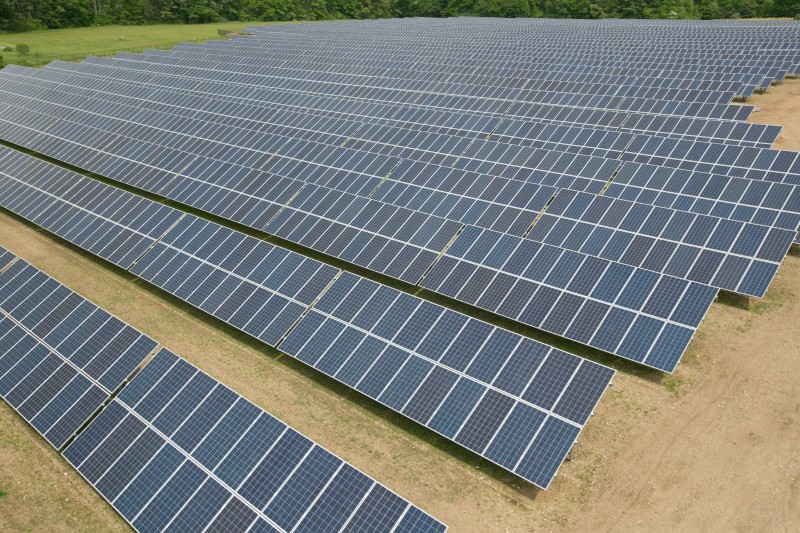
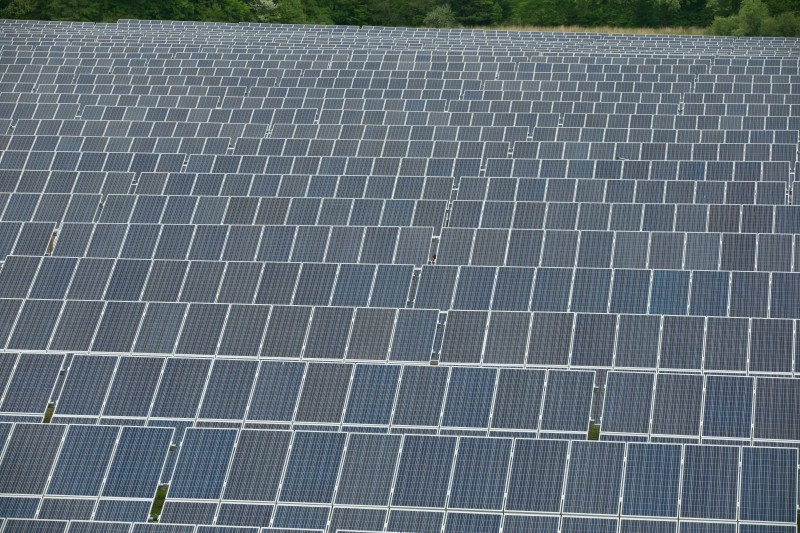
   I recently saw this solar power farm at Stonehill College in Massachusetts - fantastic to see!


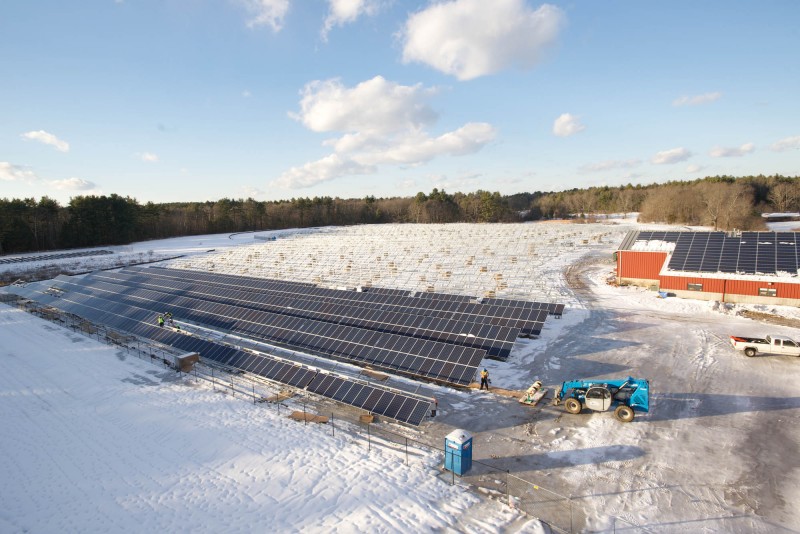
One of Nation’s Largest College Campus Solar Fields Being Built at Stonehill

January 6, 2014
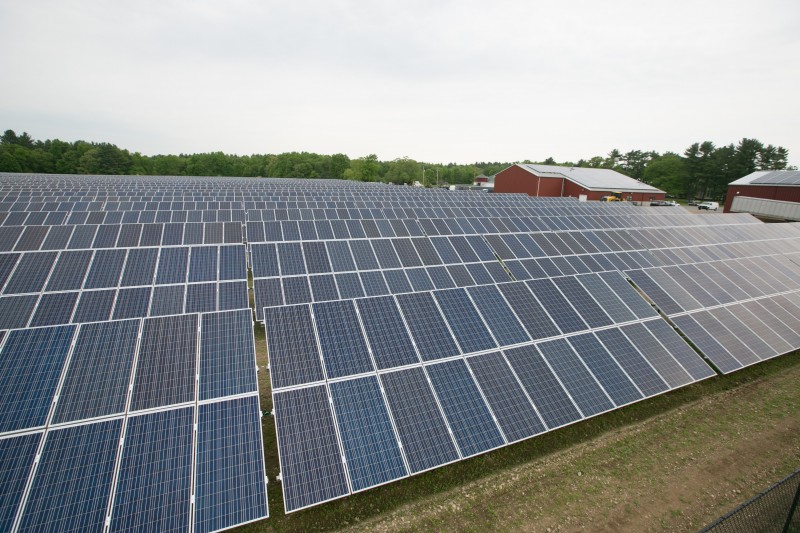


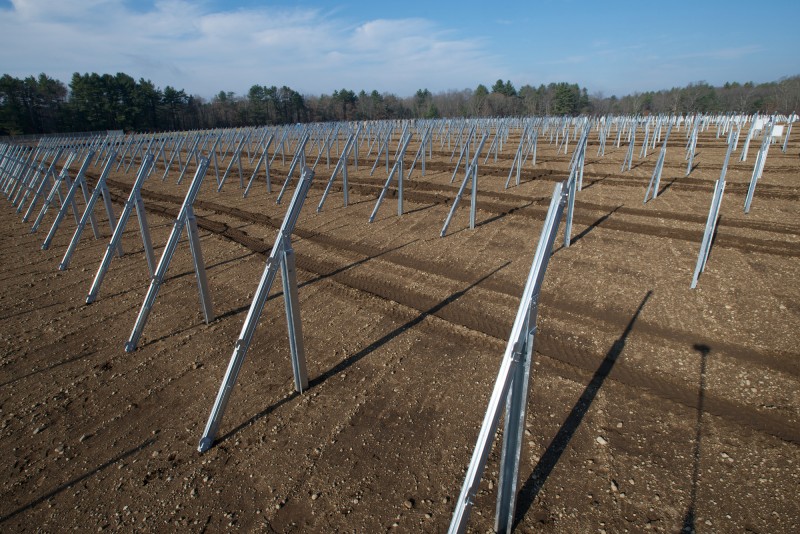
A 15-acre solar field is being built on an unused parcel of land across from Stonehill College’s main campus on Route 138 in Easton. Scheduled to be completed early in 2014, it will be 2.7 megawatts in size and contain 9,000 solar panels which will make it the 11th (tied) largest solar installation on a college campus nationwide and the largest on a New England college campus according to the Association for Advancement of Sustainability in Higher Education (AASHE) database.
The solar field is expected to save the College over $185,000 a year or an estimated $3.2 million over the course of a 15-year contract it has signed with New Jersey-based Marina Energy.  The energy produced is expected to account for 20% of Stonehill’s electrical usage.

Protecting God’s Creation

The impetus for the solar field is not just financial. The project also aligns with Stonehill’s strategic commitment to building a culture of sustainability on campus and ties in with the College’s Catholic ethos.
“The solar field is an extension to our Catholic commitment to care for creation and sustainability. It gives further indication of our commitment, on every level, to preserving the resources that are in our care for future generations,” says Rev. James Lies, C.S.C., the College’s vice president for mission.
“As Catholics, we are called upon by God to be good stewards of the earth and the natural world. We have a responsibility to use our gifts and expertise to advocate for environmental justice and to create sustainable development options,”   explains Fr. Lies.
In 2012, Stonehill became the 12th Catholic college in the United States to sign the St. Francis Pledge, which is a public promise to protect God’s creation and the environment, and to advocate for those who are impacted the most by global climate change. The pledge is named in honor of St. Francis of Assisi who is the patron saint of the environment and of animals. 

Good Stewards

Across a variety of fronts, Stonehill has taken numerous actions towards sustainability. For example, in 2012 the College phased out bottled water usage and in 2011 created The Farm at Stonehill, which supplies local food banks, soup kitchens and other meal providers with organic, sustainably grown fruits and vegetables.
Other initiatives have included composting cafeteria waste, introducing the Zip Car car-sharing option, single stream recycling and other waste reducing programs.
Once the solar field is completed, students and visitors of the College will be able to monitor the energy output from the solar field in real time on a screen which will be housed in the College’s Shield Science Center.
In addition to the 15-acre solar field, the College has also installed roof-top solar panels on two of its facilities storage buildings and has plans to install more roof-top panels throughout campus in the future.

Sustainable Partnerships

Solect Energy of Hopkinton, MA, the leading commercial solar energy project developer in the state, is building the solar field while the entire project is being overseen by Power Management, Inc., an energy consulting firm which manages over 15,000 commercial and industrial utility meters throughout North America.
“Sustainability is very much part of our strategic plan and we are alert to new opportunities,” says Craig Binney, Stonehill’s associate vice president for finance and operations.  
Through a connection with two Stonehill alumni, David Cohen ’93 and Richard Tepper ’86, College officials met with Power Management in 2011.
“We liked what we heard and, after speaking with its Vice President Kevin Kelly, we saw an opportunity for a significant sustainable initiative Binney notes.
“Solar projects take a long time to complete and it’s necessary to have a ‘champion’ for the project and I cannot say enough about the Stonehill team, especially Craig and Jeanne Finlayson (Vice President for Finance).  Despite a few setbacks with the project along the way, they really moved things along and it has been such a pleasure working with them over these last two and a half years,” Kelly says.
Solect Energy broke ground on the project beginning this fall and expects the field to be completed over the next few months.
“It has been a pleasure working in collaboration with Stonehill, Power Management and Marina Energy on a project of this magnitude,” says Scott Howe, Partner at Solect Energy Development. “Stonehill is establishing itself as a shining example of how a college can reap the benefits of making a huge commitment to sustainability by using renewable solar energy to power its campus.”
Marina Energy, which owns and operates the field, commends Stonehill for its commitment to renewable energy.
“We credit Stonehill for its forward-thinking strategies which will put the College in a strong position to lead others in New England to a more sustainable future. As more and more institutions like Stonehill College turn to cleaner, renewable sources of energy, the community thrives through financial savings and improved efficiency,” says Steve Poniatowicz, senior vice president & chief operating officer of Marina Energy.

About Stonehill

Stonehill is a selective Catholic college located near Boston on a beautiful 384-acre campus in Easton, Massachusetts. With a student-faculty ratio of 13:1, the College engages over 2,500 students in 80+ rigorous academic programs in the liberal arts, sciences, and pre-professional fields. The Stonehill community helps students to develop the knowledge, skills, and character to meet their professional goals and to live lives of purpose and integrity.

About Power Management

Power Management provides energy management and sustainability services to a diversified customer base. Founded in 1997, Power Management currently manages over 15,000 commercial and industrial utility meters throughout North America. We take energy management to a higher level through a process that includes comprehensive research, recommendation and implementation.

About Marina Energy

Marina is a wholly owned subsidiary of South Jersey Industries that develops, owns and operates on-site energy projects that include district heating and cooling, combined heat and power, solar and landfill gas-to-electric. Marina has gained significant project experience through partnering with higher education institutions within New Jersey.

About Solect Energy

Solect is a full-service solar photovoltaic (PV) project developer based in Massachusetts, delivering smart solar solutions to help businesses and organizations reduce energy costs. As an industry leader in commercial solar energy, Solect takes a practical approach to the development, installation and on-going support of each system. Solect partners closely with customers, providing strong financial insight and solar technology expertise to optimize their investment while creating a positive impact on the environment. 
The company currently has 10 MW (megawatts) of systems completed and under development, with a primary focus on New England-based commercial, light industrial, and institutional property owners. Visit www.solect.com for more information.

http://www.stonehill.edu/news-media/news/details/one-of-nations-largest-college-campus-solar-fields-being-built-at-stonehill/


Tuesday, March 25, 2014

Grid Parity - Tipping Point For Change


   While grid parity is where things are headed there are still many obstacles - starting with dollars and dollars of utility money to fight it. Start in Arizona to see the aggressive tactics used by utilities against grid parity. Grid parity will allow on-site power generation by independent and very small producers (a household) to be part of the discussion of the future of energy production in the United States, instead of  beening dismissed as insignificant. 
   Quality improvements and cost declines in batteries, as the article reports, are a major tipping point to make on-site surplus power generation practical for a growing number of people and businesses. While not mentioned in the article, there are recent significant performance improvements in small scale wind power production systems designed for residential rooftop mounting. With further price drops, a system that combines rooftop solar and wind electric production with battery backup becomes a practical goal for an urban dweller - not just off-the-grid back-to-the-hills people. Adding a solar hot water component further reduces off-site power needs.
    As more individual households become energy producers, the two-way potential of the grid begins to be realized. Up until now, the grid is primarily seen as a one-way street to the consumer. Deregulation has divided distribution from production but a lot of the same folks are still around and they would be happy if it stayed a one-way street. The continuing rise in on-site power production pushes the envelope though. I see two basic realities - first, less distributed power means less revenue and taxes and second, if a micro power producer wants to sell their power, they must be connected to the grid. Connection will cost money. Clearly a realignment of the present utilities vs. solar people paradigm is needed - the grid needs re-imagining with an emphasis on who is to receive the benefit - is it a democratic thing because everyone basically needs it or is it prone to corporate bottle-necks or choke points? 
   The inherent benefit of household power production is people keeping their money - the elimination of the massive wealth transfer from individuals to the corporations that control electricity production and distribution. People do not give up money streams without resistance. Corporations will go to great lengths to protect what they consider to be theirs. Grid parity is change - for forward looking people, it is a key element in a tipping point that can have significant effects on corporate and government revenues. Just as there are currently winners and losers, there are winners and losers to come. Hopefully these issues will soon be more commonly part of the discussion for everyone.
      

Grid parity: Why electric utilities should struggle to sleep at night

By Matt McFarland, Updated: March 25 at 9:02 am

What’s good news for those concerned with climate change, and bad news for electric utilities? That’s grid parity, which is sometimes called socket parity. It exists when an alternative energy source generates electricity at a cost matching the price of power from the electric grid.
As grid parity becomes increasingly common, renewable energy could transform our world and slow the effects of climate change. Advances in solar panels and battery storage will make it more realistic for consumers to dump their electric utility, and power their homes through solar energy that is stored in batteries for cloudy days.
“I think the grid gets disrupted,” said NRG Energy chief executive David Crane. “The only question is do you want to be the disruptor or do you want to get disrupted.”
Our world is increasingly cordless, and power appears likely to follow. While we’re not there yet, the momentum behind distributed energy is building.
The Rocky Mountain Institute has said that tens of millions of commercial and residential customers will have grid parity by 2030 and perhaps 2020. Hawaii is already there as a result of high energy costs associated with being an island.
Other estimates are more aggressive. A 2013 Deutsche Bank report said that 10 states are currently at grid parity: Arizona, California, Connecticut, Hawaii, Nevada, New Hampshire, New Jersey, New Mexico, New York and Vermont. According to a 2013 note by Citi Research, Germany, Spain, Portugal and Australia have reached grid parity.
This shift has benefited from a dramatic drop in the price of solar panels, which dropped 97.2 percent from 1975 to 2012, according to GTM Research.
For electric utilities to truly be challenged, batteries are just as important as solar panels. With batteries excess energy could be stored. Tesla announced in February it’s building a gigafactory, which it envisions producing more lithium ion batteries by 2020 than were produced worldwide in a 2013. The scale of the operation should drive down prices further (Tesla estimates over 30 percent). Some of these batteries will be used by SolarCity, a leader in installing residential solar panels.
SolarCity has a pilot program in California, in which batteries store solar power. It has complained that electric utilities are slowing its rolloutNRG Energy hopes to have a similar product available by the end of 2014.
If utilities are dragging their feet on SolarCity’s initiative, it’s easy to understand why. As solar energy gets cheaper, traditional electric utilities are doing the opposite. The cost of maintaining the electric grid has gotten more expensive, but reliability hasn’t improved. The investments of electrical utilities appear to be poorly spent.
If customers leave electric utilities, it starts a downward spiral. Fewer customers will mean higher rates, which encourages remaining customers to jump ship for a solar-battery system.
Electric utilities appear poorly equipped for how technology will transform the energy industry. For years there hasn’t been an incentive to innovate, in part due to a lack of competition. Plus, making their product cheaper means less revenue, so why innovate?
Meanwhile, energy upstarts are led by forward thinkers with disruptive track records and eyes on society’s big problems, such as climate change and our dependence on fossil fuels for energy. SolarCity chairman Elon Musk co-founded PayPal and leads Tesla, which could transform the auto industry.
NRG’s Crane speaks of having his company mentioned in the same breath as Amazon, Apple, Facebook and Google. It’s radical to imagine anyone feeling passionate about their source of power, but environmental concerns may make it common soon. New devices such as Nest’s popular thermostat are making consumers rethink what to expect from the companies and gadgets that manage their energy.
Crane highlighted the climate change concerns in a recent letter to shareholders: “The day is coming when our children sit us down in our dotage, look us straight in the eye, with an acute sense of betrayal and disappointment in theirs, and whisper to us, ‘You knew… and you didn’t do anything about it. Why?’”

Wednesday, December 25, 2013

Roof Top Solar And The Grid - Limits To Smartness?


Solar Power Growing Pains: How Will Hawaii And Germany Cope With The Boom In Alternative Energy?

on December 23 2013 2:51 PM


  • Hawaii Solar power 2013
    A view of houses with solar panels in the Mililani neighborhood on the island of Oahu in Mililani, Hawaii, December 15, 2013. Reuters


Is clean energy a victim of its own success, or is the transition from fossil fuels to alternative energy just going through some natural growing pains? However you spin it, in places like Hawaii and Germany, rooftop solar panels are popping up like weeds – but at a rate that might be too fast for utility companies to handle.
Solar panel setups can often supply enough juice to power a home, and more – with any excess electricity fed back into the grid. But this makes managing the flow of power a bit more difficult for the utility, compounded by the fact that solar power generation can fluctuate with changes in cloud cover. The result can be either a sudden draw on the grid on cloudy days, or a potentially overloading power surge on unexpectedly sunny days. Not every grid is able to cope.
In Hawaii, solar power-generating capacity has doubled just about every year since 2005, according to the Honolulu Star-Advertiser. But the utility company and the grid are struggling to keep up with this expansion. This September, the Hawaiian Electric Co. (HECO) told customers that they could no longer guarantee that certain residential solar photovoltaic (PV) systems could be interconnected with the utility grid. HECO says it’s worried that the solar power boom might lead to instability if the power generated by homeowners’ panels exceeds the output from local power plants.
"We can't allow circuits to become dangerous," Peter Rosegg, a HECO spokesman, told ClimateWire. "We can't allow circuits to become unreliable because there's too much PV on those circuits."
Many Hawaiians are frustrated. Take William Walker, who spent $35,000 for a rooftop solar PV system for his Oahu home, only to be left off the grid thanks to the new HECO policy. Now he has to keep paying his monthly $250 electric bill to HECO along with the $300 monthly payments on his solar panels. Walker told ClimateWire that he's not completely buying HECO’s explanation for the policy change.
“My belief is it's purely profit-motivated, to keep people away from PV and keep them on the grid,” Walker said.
And Walker's situation is hardly unique. Even though HECO will be grandfathering in more than 200 customers who submitted what are called "net energy metering" agreements -- which certify that a solar power system has been installed and approved by a licensed electrical contractor -- before a September deadline, hundreds more are still left in limbo, according to Honolulu Civil Beat. It's unclear when their systems will be able to be connected up.
Other U.S. states are eyeing how Hawaii balances solar and conventional power to avoid overloading the grid.
"As an engineer, you always want to look at the worst-case scenario. Well, [Hawaii has] it," Elaine Sison-Lebrilla, a project manager for Sacramento, Calif.'s publicly owned utility, told the Los Angeles Times in November.
Though its climate might be radically different, Germany is facing a problem similar to Hawaii's in the midst of its solar boom. Experts predict that solar-generated power may soon be able to power the whole country – but only during the sunniest hours, between noon and 2 p.m. That midday bulge is problematic for the grid.
“Any further [solar] installations beyond this point could push structural solar power supply above demand and cause permanent midday grid instability,” Citigroup researcher Jason Channell wrote in a report quoted by Business Insider.
The hope may lie in smart grids that use advanced communications networks to better juggle the production of electricity from multiple sources, as well as large-scale batteries that could store excess solar power. But neither option is especially cheap. A 2009 report from NPR estimated the cost of overhauling the grid across America at somewhere between $100 billion and $2 trillion.
Some solar advocates have faith that the market will adjust as PV systems become more popular. It is for that reason, research institute Fraunhofer ISE said in a report this past September [PDF], that Germany should not try to halt the solar power boom to wait for storage technology to catch up.
“Investing in storage is first profitable when large price differences for electricity frequently occur,” Fraunhofer ISE’s Harry Wirth wrote. “Continued, further expansion in PV and wind capacity will cause prices on the electricity exchange… to sink more often and more drastically.”

http://www.ibtimes.com/solar-power-growing-pains-how-will-hawaii-germany-cope-boom-alternative-energy-1518702