Showing posts with label electricity. Show all posts

Sunday, August 17, 2014

Solar Power Farm At New England College

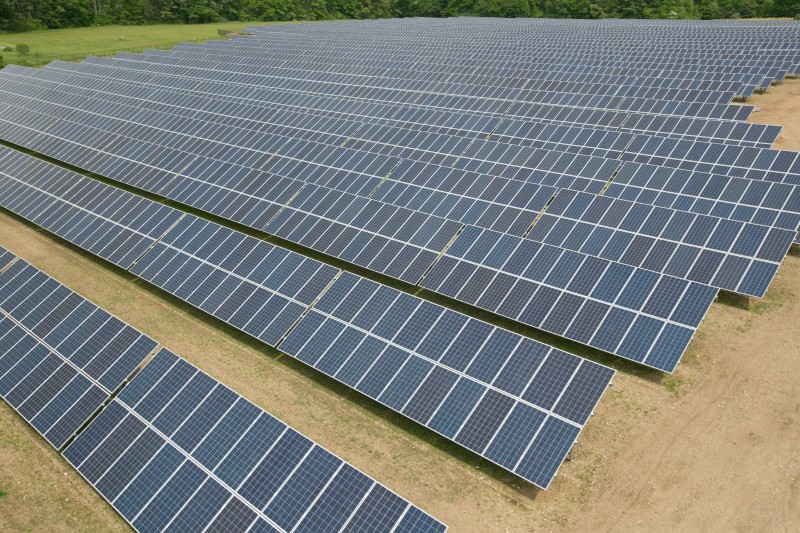
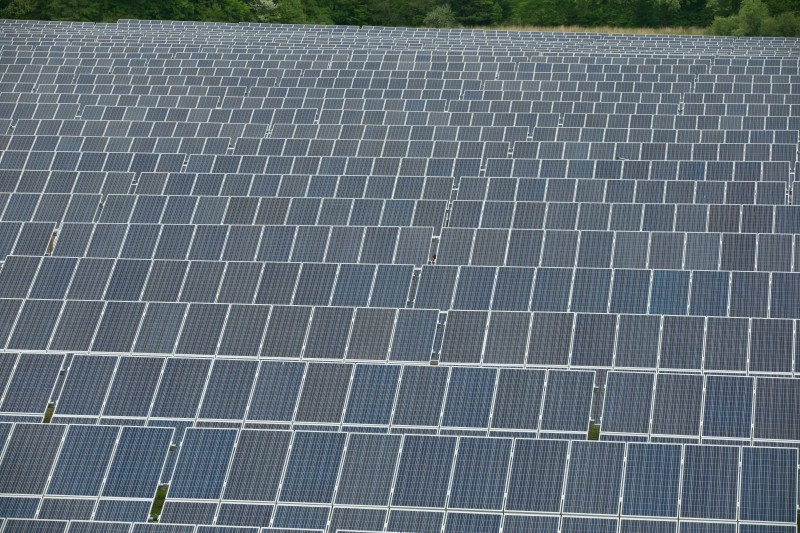
   I recently saw this solar power farm at Stonehill College in Massachusetts - fantastic to see!


One of Nation’s Largest College Campus Solar Fields Being Built at Stonehill

January 6, 2014
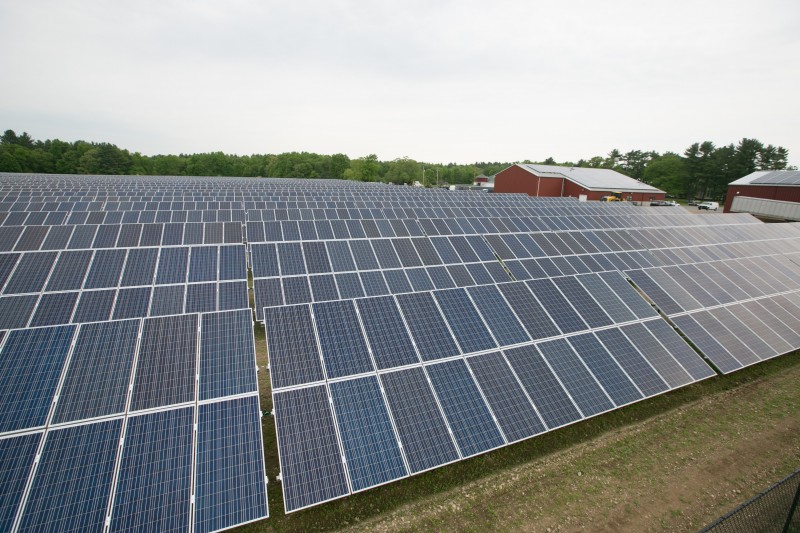


A 15-acre solar field is being built on an unused parcel of land across from Stonehill College’s main campus on Route 138 in Easton. Scheduled to be completed early in 2014, it will be 2.7 megawatts in size and contain 9,000 solar panels which will make it the 11th (tied) largest solar installation on a college campus nationwide and the largest on a New England college campus according to the Association for Advancement of Sustainability in Higher Education (AASHE) database.
The solar field is expected to save the College over $185,000 a year or an estimated $3.2 million over the course of a 15-year contract it has signed with New Jersey-based Marina Energy.  The energy produced is expected to account for 20% of Stonehill’s electrical usage.

Protecting God’s Creation

The impetus for the solar field is not just financial. The project also aligns with Stonehill’s strategic commitment to building a culture of sustainability on campus and ties in with the College’s Catholic ethos.
“The solar field is an extension to our Catholic commitment to care for creation and sustainability. It gives further indication of our commitment, on every level, to preserving the resources that are in our care for future generations,” says Rev. James Lies, C.S.C., the College’s vice president for mission.
“As Catholics, we are called upon by God to be good stewards of the earth and the natural world. We have a responsibility to use our gifts and expertise to advocate for environmental justice and to create sustainable development options,”   explains Fr. Lies.
In 2012, Stonehill became the 12th Catholic college in the United States to sign the St. Francis Pledge, which is a public promise to protect God’s creation and the environment, and to advocate for those who are impacted the most by global climate change. The pledge is named in honor of St. Francis of Assisi who is the patron saint of the environment and of animals. 

Good Stewards

Across a variety of fronts, Stonehill has taken numerous actions towards sustainability. For example, in 2012 the College phased out bottled water usage and in 2011 created The Farm at Stonehill, which supplies local food banks, soup kitchens and other meal providers with organic, sustainably grown fruits and vegetables.
Other initiatives have included composting cafeteria waste, introducing the Zip Car car-sharing option, single stream recycling and other waste reducing programs.
Once the solar field is completed, students and visitors of the College will be able to monitor the energy output from the solar field in real time on a screen which will be housed in the College’s Shield Science Center.
In addition to the 15-acre solar field, the College has also installed roof-top solar panels on two of its facilities storage buildings and has plans to install more roof-top panels throughout campus in the future.

Sustainable Partnerships

Solect Energy of Hopkinton, MA, the leading commercial solar energy project developer in the state, is building the solar field while the entire project is being overseen by Power Management, Inc., an energy consulting firm which manages over 15,000 commercial and industrial utility meters throughout North America.
“Sustainability is very much part of our strategic plan and we are alert to new opportunities,” says Craig Binney, Stonehill’s associate vice president for finance and operations.  
Through a connection with two Stonehill alumni, David Cohen ’93 and Richard Tepper ’86, College officials met with Power Management in 2011.
“We liked what we heard and, after speaking with its Vice President Kevin Kelly, we saw an opportunity for a significant sustainable initiative Binney notes.
“Solar projects take a long time to complete and it’s necessary to have a ‘champion’ for the project and I cannot say enough about the Stonehill team, especially Craig and Jeanne Finlayson (Vice President for Finance).  Despite a few setbacks with the project along the way, they really moved things along and it has been such a pleasure working with them over these last two and a half years,” Kelly says.
Solect Energy broke ground on the project beginning this fall and expects the field to be completed over the next few months.
“It has been a pleasure working in collaboration with Stonehill, Power Management and Marina Energy on a project of this magnitude,” says Scott Howe, Partner at Solect Energy Development. “Stonehill is establishing itself as a shining example of how a college can reap the benefits of making a huge commitment to sustainability by using renewable solar energy to power its campus.”
Marina Energy, which owns and operates the field, commends Stonehill for its commitment to renewable energy.
“We credit Stonehill for its forward-thinking strategies which will put the College in a strong position to lead others in New England to a more sustainable future. As more and more institutions like Stonehill College turn to cleaner, renewable sources of energy, the community thrives through financial savings and improved efficiency,” says Steve Poniatowicz, senior vice president & chief operating officer of Marina Energy.

About Stonehill

Stonehill is a selective Catholic college located near Boston on a beautiful 384-acre campus in Easton, Massachusetts. With a student-faculty ratio of 13:1, the College engages over 2,500 students in 80+ rigorous academic programs in the liberal arts, sciences, and pre-professional fields. The Stonehill community helps students to develop the knowledge, skills, and character to meet their professional goals and to live lives of purpose and integrity.

About Power Management

Power Management provides energy management and sustainability services to a diversified customer base. Founded in 1997, Power Management currently manages over 15,000 commercial and industrial utility meters throughout North America. We take energy management to a higher level through a process that includes comprehensive research, recommendation and implementation.

About Marina Energy

Marina is a wholly owned subsidiary of South Jersey Industries that develops, owns and operates on-site energy projects that include district heating and cooling, combined heat and power, solar and landfill gas-to-electric. Marina has gained significant project experience through partnering with higher education institutions within New Jersey.

About Solect Energy

Solect is a full-service solar photovoltaic (PV) project developer based in Massachusetts, delivering smart solar solutions to help businesses and organizations reduce energy costs. As an industry leader in commercial solar energy, Solect takes a practical approach to the development, installation and on-going support of each system. Solect partners closely with customers, providing strong financial insight and solar technology expertise to optimize their investment while creating a positive impact on the environment. 
The company currently has 10 MW (megawatts) of systems completed and under development, with a primary focus on New England-based commercial, light industrial, and institutional property owners. Visit www.solect.com for more information.

http://www.stonehill.edu/news-media/news/details/one-of-nations-largest-college-campus-solar-fields-being-built-at-stonehill/


Tuesday, March 25, 2014

Grid Parity - Tipping Point For Change


   While grid parity is where things are headed there are still many obstacles - starting with dollars and dollars of utility money to fight it. Start in Arizona to see the aggressive tactics used by utilities against grid parity. Grid parity will allow on-site power generation by independent and very small producers (a household) to be part of the discussion of the future of energy production in the United States, instead of  beening dismissed as insignificant. 
   Quality improvements and cost declines in batteries, as the article reports, are a major tipping point to make on-site surplus power generation practical for a growing number of people and businesses. While not mentioned in the article, there are recent significant performance improvements in small scale wind power production systems designed for residential rooftop mounting. With further price drops, a system that combines rooftop solar and wind electric production with battery backup becomes a practical goal for an urban dweller - not just off-the-grid back-to-the-hills people. Adding a solar hot water component further reduces off-site power needs.
    As more individual households become energy producers, the two-way potential of the grid begins to be realized. Up until now, the grid is primarily seen as a one-way street to the consumer. Deregulation has divided distribution from production but a lot of the same folks are still around and they would be happy if it stayed a one-way street. The continuing rise in on-site power production pushes the envelope though. I see two basic realities - first, less distributed power means less revenue and taxes and second, if a micro power producer wants to sell their power, they must be connected to the grid. Connection will cost money. Clearly a realignment of the present utilities vs. solar people paradigm is needed - the grid needs re-imagining with an emphasis on who is to receive the benefit - is it a democratic thing because everyone basically needs it or is it prone to corporate bottle-necks or choke points? 
   The inherent benefit of household power production is people keeping their money - the elimination of the massive wealth transfer from individuals to the corporations that control electricity production and distribution. People do not give up money streams without resistance. Corporations will go to great lengths to protect what they consider to be theirs. Grid parity is change - for forward looking people, it is a key element in a tipping point that can have significant effects on corporate and government revenues. Just as there are currently winners and losers, there are winners and losers to come. Hopefully these issues will soon be more commonly part of the discussion for everyone.
      

Grid parity: Why electric utilities should struggle to sleep at night

By Matt McFarland, Updated: March 25 at 9:02 am

What’s good news for those concerned with climate change, and bad news for electric utilities? That’s grid parity, which is sometimes called socket parity. It exists when an alternative energy source generates electricity at a cost matching the price of power from the electric grid.
As grid parity becomes increasingly common, renewable energy could transform our world and slow the effects of climate change. Advances in solar panels and battery storage will make it more realistic for consumers to dump their electric utility, and power their homes through solar energy that is stored in batteries for cloudy days.
“I think the grid gets disrupted,” said NRG Energy chief executive David Crane. “The only question is do you want to be the disruptor or do you want to get disrupted.”
Our world is increasingly cordless, and power appears likely to follow. While we’re not there yet, the momentum behind distributed energy is building.
The Rocky Mountain Institute has said that tens of millions of commercial and residential customers will have grid parity by 2030 and perhaps 2020. Hawaii is already there as a result of high energy costs associated with being an island.
Other estimates are more aggressive. A 2013 Deutsche Bank report said that 10 states are currently at grid parity: Arizona, California, Connecticut, Hawaii, Nevada, New Hampshire, New Jersey, New Mexico, New York and Vermont. According to a 2013 note by Citi Research, Germany, Spain, Portugal and Australia have reached grid parity.
This shift has benefited from a dramatic drop in the price of solar panels, which dropped 97.2 percent from 1975 to 2012, according to GTM Research.
For electric utilities to truly be challenged, batteries are just as important as solar panels. With batteries excess energy could be stored. Tesla announced in February it’s building a gigafactory, which it envisions producing more lithium ion batteries by 2020 than were produced worldwide in a 2013. The scale of the operation should drive down prices further (Tesla estimates over 30 percent). Some of these batteries will be used by SolarCity, a leader in installing residential solar panels.
SolarCity has a pilot program in California, in which batteries store solar power. It has complained that electric utilities are slowing its rolloutNRG Energy hopes to have a similar product available by the end of 2014.
If utilities are dragging their feet on SolarCity’s initiative, it’s easy to understand why. As solar energy gets cheaper, traditional electric utilities are doing the opposite. The cost of maintaining the electric grid has gotten more expensive, but reliability hasn’t improved. The investments of electrical utilities appear to be poorly spent.
If customers leave electric utilities, it starts a downward spiral. Fewer customers will mean higher rates, which encourages remaining customers to jump ship for a solar-battery system.
Electric utilities appear poorly equipped for how technology will transform the energy industry. For years there hasn’t been an incentive to innovate, in part due to a lack of competition. Plus, making their product cheaper means less revenue, so why innovate?
Meanwhile, energy upstarts are led by forward thinkers with disruptive track records and eyes on society’s big problems, such as climate change and our dependence on fossil fuels for energy. SolarCity chairman Elon Musk co-founded PayPal and leads Tesla, which could transform the auto industry.
NRG’s Crane speaks of having his company mentioned in the same breath as Amazon, Apple, Facebook and Google. It’s radical to imagine anyone feeling passionate about their source of power, but environmental concerns may make it common soon. New devices such as Nest’s popular thermostat are making consumers rethink what to expect from the companies and gadgets that manage their energy.
Crane highlighted the climate change concerns in a recent letter to shareholders: “The day is coming when our children sit us down in our dotage, look us straight in the eye, with an acute sense of betrayal and disappointment in theirs, and whisper to us, ‘You knew… and you didn’t do anything about it. Why?’”

Wednesday, December 25, 2013

Battery Back Up For Solar

From The New York Times -

December 4, 2013

SolarCity to Use Batteries From Tesla for Energy Storage

Commercial building owners, even those who reduce their overall energy use, have long struggled to cut special power fees that are based on periods of highest demand.
Now, SolarCity, the fast-growing solar installer, says it has found a solution, in the form of a battery system created with Tesla Motors.
The system, to be announced on Thursday, includes batteries about the size of a small refrigerator and software that controls when a building’s operations run on power from the solar array, the battery or the grid.
Called DemandLogic, it could allow businesses to use stored electricity in times of highest demand, which would reduce their usage at peak periods and the associated fees, called demand charges.
“We are providing them a solution to reduce their energy cost and demand cost,” said Lyndon Rive, SolarCity’s chief executive, adding that the systems would provide backup power and a working solar array during blackouts. Although he said he did not see the systems as a step toward independence from the grid, storage would be important to maintaining grid stability as more customers adopt solar.
The product grew from a $1.8 million grant in 2010 from the California Public Utilities Commission to study the possibilities of storing electricity from rooftop solar arrays in batteries. The company has also signed up about 300 of its residential customers for a pilot program using battery packs from Tesla, whose chief executive, Elon Musk, is the chairman of SolarCity and Mr. Rive’s cousin.
The company will begin offering its storage systems in parts of California, Connecticut and Massachusetts. Although the combination of solar with storage could prove potent, said Sam Jaffe, a senior research analyst at Navigant Research, the market for it is by no means assured.
“It’s not a no-brainer — you still have to have the exact right combination of rates and demand charges and the cost of that equipment,” he said. He added, though, that if the systems are configured to take advantage of a 30 percent federal tax credit, the economics would have broader appeal.
The SolarCity systems, which are designed to be eligible for the credit, will be made available to new solar customers signing 10-year service agreements and are made to store about a third of the energy the solar array can produce. Mr. Rive said the company would guarantee the demand charge reductions, which he expects to run around 20 percent.
The demand charges, meant to compensate the utility for capital investments in distribution infrastructure, are based on so-called peak demand, or the highest amount of electricity used within the billing period. So even companies using less electricity overall can incur high fees. Part of the appeal for businesses trying to reduce their electric loads is that the system allows them to continue operating at full capacity, rather than reducing power usage, as in traditional demand response programs, Mr. Rive said.


http://www.nytimes.com/2013/12/05/business/energy-environment/solarcity-to-use-batteries-from-tesla-for-energy-storage.html?emc=eta1&_r=0

Sunday, December 22, 2013

Water Company Goes Solar

Utilizing off the shelf technology -

WSSC turns to solar power to cut sewage- treatment electricity costs

By , Published: December 21

On a recent gray December morning, nearly 8,500 solar panels covering 13 acres in Germantown tilted toward the sky, straining to harness any glimmer of sunlight.
Their host: a sewage-treatment plant in Montgomery County, one of the first in the Washington region to try solar power. The panels, also installed at a Washington Suburban Sanitary Commission facility in Upper Marlboro, began operating in October.
Solar panels are expected to provide up to one-fifth of the two plants’ electrical needs at rates 25 percent cheaper than traditional electricity, WSSC officials said. (And, yes, if it’s a cloudy day or the middle of the night, your toilet will still flush.)
“For a utility, it’s a huge milestone, because very few have solar power,” said Rob Taylor, the WSSC’s energy manager. “If we can show we can buy alternative energy cheaper than conventional energy, it’s a win-win situation.”
The idea is catching on with water and sewer utilities across the country, in part because they guzzle electricity. Operating round-the-clock, the facilities run enormous pumps to deliver drinking water and then use huge blowers, centrifuges and other equipment to treat sewage and return the disinfected water to local rivers. Those energy costs can fluctuate dramatically, putting pressure on operating budgets, utility officials say.
“We’re a massive energy user, and we pay a pretty penny for it,” said George S. Hawkins, DC Water’s general manager.
Sewage-treatment plants, in particular, are being looked at for solar power because vast parcels of land bought decades ago as buffers for nearby communities can accommodate acres of the panels. Meanwhile, the panels’ prices have dropped significantly in recent years, helping utilities achieve bigger savings.
Utility officials say they also are exploring ways to reduce their dependence on the electrical grid during and after severe storms, when power outages can wreak havoc on sewer systems and cause overflows into streams.
It’s also about saving money. DC Water, the largest consumer of electricity in the District, is installing equipment similar to a giant pressure cooker at its Blue Plains Advanced Wastewater Treatment Plant in Southwest Washington. The equipment will “cook” and sterilize the brown, goopy sludge collected from treated sewage and turn it into food for methane-generating bacteria. The methane gas will then be burned to power steam turbines that produce electricity, officials said.
DC Water officials said they expect the system to save the utility $10 million in electricity costs — and another $10 million in trucking costs because half as much sludge will need to be hauled away. The utility also is exploring selling the sterilized sludge as fertilizer, Hawkins said.
The annual savings are expected to more than cover the debt service on the $470 million borrowed for the project, Hawkins said. That will free up money needed to repair and replace aging infrastructure, such as underground pipes that burst after too much decay, he said.
Hawkins, the former head of the District’s Department of the Environment, said the new process also is expected to cut the treatment plant’s greenhouse gas emissions by one-third. “We’re very aware of the fact that a lot of the energy we’re using is coming from big Midwestern coal plants with quite a big environmental footprint,” Hawkins said.
Blue Plains has less open land available for solar panels than some other treatment plants, he said. Still, DC Water is considering putting panels on underground settling tanks and other structures on the 150-acre campus.
Howard County officials began looking at alternative energy sources last year, after Hurricane Sandy knocked out power to the Little Patuxent Water Reclamation Plant in Savage. The outage caused 19 million gallons of diluted but untreated sewage to flow into Little Patuxent River, officials said.
The county is installing three diesel-powered generators to provide backup power, along with a solar panel system to offset the diesel emissions and provide alternative power.
The solar panels are projected to save about $22,800 in annual electricity costs and offset the generators’ carbon dioxide emissions by 150 percent, Howard officials said.
“If we’re going to be able to expand our solar capacity, we have to creatively look at publicly owned infrastructure that has capacity” for solar equipment, Howard County Executive Ken Ulman (D) said. “Especially in urban areas, treatment plants are a big part of the solution.”
In Northern Virginia, Fairfax Water officials recently determined that it would take too long — 36 years — for the annual electricity savings to cover the costs of installing solar panels at a large drinking-water filtration plant, said Shawn O’Neill, the utility’s manager of energy programs.
However, he said Fairfax Water is considering solar-powered security cameras, outdoor lights and office building heating. O’Neill said solar power would be especially useful to automate remote valves that now must be operated manually in areas with no electricity.
The WSSC solar program is a public-private partnership. Washington Gas Energy Systems paid the $12 million to install the solar panels and will operate them for 20 years. The WSSC pays only for the solar power it uses. WSSC officials say they expect to save $3.5 million total in electricity costs over the 20 years and cut the two plants’ annual carbon dioxide emissions by 3,200 metric tons — described as the equivalent of taking 665 cars off the road.
Scott Wiater, president of Rockville-based Standard Solar, which installed the WSSC solar panels and will maintain them, said utilities are focused on those savings.
“They’re doing it for the bottom line. That’s the primary driver,” Wiater said. “The feel-good environmental aspects are just gravy for them.”


http://www.washingtonpost.com/local/trafficandcommuting/wssc-turns-to-solar-power-to-cut-sewage--treatment-electricity-costs/2013/12/21/84d3db8c-6801-11e3-ae56-22de072140a2_story.html?hpid=z7

Sunday, November 3, 2013

US Army Leading Trash To Gas Efforts

From The New York Times -


August 17, 2013

Trash Into Gas, Efficiently? An Army Test May Tell

THERE is an indisputable elegance to the idea of transforming garbage into fuel, of turning icky, smelly detritus into something valuable.
But big drawbacks have prevented the wholesale adoption of trash-to-gas technology in the United States: incineration is polluting, and the capital costs of new plants are enormous. Gasification systems can expend a tremendous amount of energy to produce a tiny amount of electricity. Up to this point, it hasn’t seemed worth the trouble.
Mike Hart thinks that he has solved those problems. In a former Air Force hangar outside Sacramento, his company, Sierra Energy, has spent the last several years testing a waste-to-energy system called the FastOx Pathfinder. The centerpiece, a waste gasifier that’s about the size of a shower stall, is essentially a modified blast furnace. A chemical reaction inside the gasifier heats any kind of trash — whether banana peels, used syringes, old iPods, even raw sewage — to extreme temperatures without combustion. The output includes hydrogen and carbon monoxide, which together are known as syngas, for synthetic gas, and  can be burned to generate electricity or made into ethanol or diesel fuel. The FastOx is now being prepared for delivery to Sierra Energy’s first customer: the United States Army.
Ethanol has long been promoted as an alternative fuel that increases energy independence, and federal law requires the use of greater amounts of it. But most ethanol in this country is produced from corn, and many people worry that the mandate is pushing up food prices. Ethanol produced from trash — or agricultural waste, as others are trying — would allay such concerns.
Ineos Bio, a Florida company, announced last month that it had produced ethanol from gasified wood waste, using a method that it expects to be commercially viable, and KiOR Inc. will make one million to two million gallons of diesel and gasoline this year from wood waste at its plant in Columbus, Miss., according to Michael McAdams, president of the Advanced Biofuels Association. Mr. Hart said Sierra Energy’s technology should be complementary with the Florida company’s; the FastOx turns all municipal waste, not just wood scraps, into a gas that Ineos Bio could then transform into ethanol.
The FastOx gasifier is the brainchild of two former engineers at Kaiser Steel, patented by the grandson of one of them and commercialized by Mr. Hart. “It’s a modular system that can be dropped into any area,” Mr. Hart said, “using waste where it’s produced to make electricity where it’s used.” Once it’s off the ground, he said, “garbage will be a commodity.”  
From concept to construction, the story of the FastOx is of one fortuitous accident after another. And while Sierra Energy has not yet proved to be a successful company — it will be a long while before your garbage is shoveled into a FastOx — its system has become the first waste-to-energy technology acquired by the Defense Department, which paid $3 million for it through an environmental technology program. (The California Energy Commission, which supports renewable energy development in the state, also gave Sierra $5 million, to cover the portion of Sierra’s costs that the Pentagon couldn’t.)
The military is looking for ways to reduce its oil consumption, and to make it easier to supply the front lines with the fuel it uses in all its vehicles and generators. “These days, the supply lines are in the battlefield,” said Sharon E. Burke, the assistant secretary of defense for operational efficiency plans and programs. “And we consume a lot of fuel, which makes us a big target.”
MIKE HART got into the energy business by way of a train. In 1993, he bought the Sierra Railroad, a small freight and tourism line in Northern California. During the California blackouts of 2001, he had an idea: “As the lights were going out, I realized every one of my locomotives creates 2.1 megawatts of electricity,” he said — enough to power many hundred homes. “It’s a rolling generator, and inexpensive.”
The train-as-power-generator idea never really left the station, but it got Mr. Hart thinking about alternative energy. Then, as part of a settlement after a fuel spill from one of his trains, he promised to convert his trains to nonpolluting biodiesel.
Biodiesel, however, proved hard to find, and Mr. Hart started looking for new ways to source it. In 2002, he was asked to judge an annual business plan competition called the Big Bang, at the University of California, Davis. That’s where he met Chris Kasten.
Mr. Kasten came to the competition with an idea to use a modified blast furnace to turn waste into fuel. His grandfather, Bruce Claflin, a retired chief industrial engineer at Kaiser Steel in Fontana, Calif., had given him the idea.
Kaiser used blast furnaces to make steel, and Mr. Claflin and a colleague, John Jasbinsek, were tasked with finding “a way to make the blast furnace more efficient and less polluting,” said Mr. Jasbinsek, who is now 86.
Like all blast furnaces, Kaiser’s emitted a flue gas out of the top. It occurred to Mr. Clafin and Mr. Jasbinsek that this gas might have value. The two came up with the idea of injecting oxygen, instead of the atmospheric air that steel makers had always used, to create the chemical reaction that heats the inside of the furnace. This would cut pollution while raising the energy content of the flue gas — in essence, giving the steel maker a second product. But pure oxygen made the system too hot, so they added steam. This gave the furnace a third product: hydrogen, which can be used to produce electricity in fuel cells.
After Kaiser decided to close the Fontana plant in 1983, workers were told to toss all demolition debris into the blast furnace. It was then that Mr. Jasbinsek and Mr. Claflin realized that the furnace could take garbage, too. “No matter what they put in, the furnace melted and gasified it,” Mr. Kasten said. This meant a potential fourth revenue stream — from taking municipal waste that would otherwise go to landfills.
When Kaiser wasn’t interested, Mr. Jasbinsek recalled, “we took the idea to other steel companies, too.” But “nobody gave a damn!” he said. “Now there are hardly any steel companies left in the U.S.”
Kaiser Steel went bankrupt in 1987, so the idea belonged to Mr. Jasbinsek and Mr. Claflin. They were nearing retirement, though, so Mr. Claflin told his grandson about it. (Mr. Claflin died before the idea could be commercialized.)
Mr. Kasten’s first fruitful step in developing his grandfather’s idea was meeting with Chris Soderquist, founder of Venture Lab. “When you run a technology incubator, you see a lot of crazy and half-baked ideas,” Mr. Soderquist said. But Mr. Kasten’s was different; Mr. Soderquist could see right away the value of multiple revenue streams.
Gasification is more efficient than incineration and eliminates toxic byproducts that come from burning trash. But it was especially appealing from a business point of view because it relied on a proven technology and used materials in wide abundance: blast furnaces being abandoned as the American steel industry was collapsing.
“What was compelling from the start,” Mr. Soderquist said, “was repurposing existing infrastructure into a generator of clean energy, with a second revenue stream from people paying you to take their waste.”
Mr. Soderquist helped Mr. Kasten prepare for the Big Bang competition. “For a grad school business plan competition, it was quite a plan he presented,” Mr. Soderquist said, and the judges agreed: Mr. Kasten, now 43, won a $2,000 prize.
Mr. Hart, 51, as a competition judge and a serial entrepreneur, was intrigued. He had started his first business at 12, operating a string of candy machines in high schools throughout what would become known as Silicon Valley. Next, while still living at home, he opened a sort of temp agency for teenagers doing odd jobs. There were a lot of other businesses from the late 1970s to 1993, and stints as a developer for Steve Jobs’s company Next, and for Apple. Mr. Hart also did some consulting until he realized that he would make more money buying whatever devalued company he had been hired to help, and turning it around himself. That was when he bought the Sierra Railroad.
Mr. Hart checked out Mr. Kasten’s gasifier and decided to buy the patents. Then he applied to a Pentagon program established to shepherd proven concepts to the production stage. Results at the Defense Department’s testing facility near Sacramento have been promising; after about four hours, one ton of waste creates enough gas to produce 1,580 kilowatt-hours of electricity, which would power an average home in the United States for about a month and a half — at one-third the emissions of coal — and 42 gallons of renewably sourced fuel. And that’s with a 12-ton-a-day gasifier; existing blast furnaces can handle as much as 2,000 tons a day.
Now that the Pentagon is convinced that the FastOx will work as advertised, the system should be providing electricity later this year at Fort Hunter Liggett, a  training base in Monterey County, Calif., and fuel for vehicles and generators in early 2014.
“California produces 30 million tons of garbage a year,” Mr. Hart said. “If it decided to turn its waste into clean fuels, at that rate it could meet all its oil consumption needs and still export more fuel than some OPEC members.” That is, if the FastOx can do what no other waste-to-energy gasification technology has done before: take any kind of trash, in any succession, without additional separation or preparation.
Sierra plans to license its technology and to sell systems to make electricity or ethanol from the syngas produced by the FastOx. The first will be small and cost about $3 million. But Mr. Hart said he expects to sell larger systems to municipalities and biofuel makers that will go for much more.
Any waste-to-energy plan, however, must overcome a major hurdle: the wild inconsistency of the waste stream. “Until you’ve demonstrated that you can handle it all, nobody’s interested,” Mr. Hart said. “I can understand it; they’ve heard similar promises before. We’ve got 150 cities, communities and businesses lined up to be Serial No. 2. Nobody wants to be No. 1.”
NOBODY, that is, except the Pentagon. The Defense Department is the country’s largest single consumer of energy, spending $15 billion a year just on fuel.
“The mission drives this,” said Ms. Burke, the assistant defense secretary, “and the mission is inherently energy-intensive.”
The FastOx could reduce the military’s reliance on oil overseas and the grid at home. “I have a $24 million-a-year electric bill at Camp Pendleton” in Southern California, said that Marine base’s commander, Brig. Gen. Vincent A. Coglianese. “If I can reduce that cost, that’s more money I can put into training Marines and sailors.”
Ms. Burke added, “Something for military operations has to be really rugged, deployable, simple to use — all of those things.”
Consultants and municipal sanitation officials who’ve looked at the FastOx say it meets those criteria. John Conger, the acting deputy under secretary of defense for installations and the environment, who oversees management of military bases in the United States, says Sierra Energy’s technology should provide energy security for the military in the event of a blackout and provide budget savings as well.
The military’s cost of petroleum, when the costs of transporting and guarding it are factored in, can run as high as $50 a gallon. Moreover, about half of United States casualties in Iraq and Afghanistan between 2003 and 2007 were of servicemen and servicewomen moving and protecting fuel convoys, according to an Army report.
The appeal of Mr. Hart’s Pathfinder system is that it would produce fuel on site, eliminating the need to truck in fuel to dangerous military outposts. It would also reduce the need for trash-burning on bases, which creates pollution and noxious odors that have contributed to locals’ distaste for the American presence in Iraq and Afghanistan.  As a result, United States forces in Afghanistan are working to close burn pits.
“Waste is a problem,” Ms. Burke said. “So if we could dispose of waste and create energy at the same time, that would be a silver bullet.”
This article has been revised to reflect the following correction:
Correction: August 25, 2013
An article last Sunday about a Sierra Energy gasifier system that the Army will use to turn trash into energy referred incorrectly to a product of the system. It is hydrogen and carbon monoxide, together known as “syngas,” for synthetic gas; the system does not produce “synthetic natural gas.” The article also referred imprecisely to Fort Hunter Liggett, a training base in Monterey County, Calif. At more than 165,000 acres, it is not a “small” base.
This article has been revised to reflect the following correction:
Correction: September 1, 2013


http://www.nytimes.com/2013/08/18/business/trash-into-gas-efficiently-an-army-test-may-tell.html

Encouraging Electric Vehicles In The US

From The Washington Post - encouraging electric vehicles - notye the serious increase in sales already - very small numbers but jumbo percentages.

Eight-state coalition plans incentives for zero emission vehicles

By , Published: October 24

A coalition of eight states announced plans Thursday to boost the use of electric cars and other zero emission vehicles, promising incentives and an improved network of fueling stations to encourage consumers to buy the vehicles and prompt manufacturers to produce more of them.
The eight governors who signed the agreement, including Maryland Gov. Martin O’Malley (D), hope to put at least 3.3 million zero emission vehicles on their roads by 2025. To accomplish that, they pledged to install more electric charging stations, introduce or continue tax breaks for consumers and add such vehicles to government fleets. Some other states have similar incentives, though they did not join the group.
Collectively, the eight states — California, Connecticut, Maryland, Massachusetts, New York, Oregon, Rhode Island and Vermont — represent about 23 percent of the U.S. auto market, according to information the group released Thursday.
“We think it’s doable,” said Mary Nichols, chairman of the Air Resources Board in California, the biggest market in the group. “The market is moving fast. It started from zero and it accelerated very quickly.”
Nichols and others said the greatest obstacle to overcome is consumer resistance to new technology. Buyers must be convinced that the vehicles will work for them, she said, a process that usually requires seeing them on the road or in a neighbor’s driveway — not just in an advertisement.
“Once we are able to get the word out to consumers that there is an infrastructure out there, and [it is] all over the state … we’ll be able to encourage a greater desire to get an electric vehicle in Maryland,” said Samantha Kappalman, a spokeswoman for O’Malley.
U.S. motorists bought about 52,000 electric cars in 2012, up from about 17,000 in 2011, according to the group. More than 40,000 plug-in cars were sold in the first half of 2013. In addition to all-electric cars, the group wans to encourage production and purchase of fuel cell vehicles, which run on hydrogen, and plug-in hybrids , which have both electric and gasoline engines.
Fossil fuels burned to power cars, trucks, ships, trains and planes were responsible for 28 percent of U.S. greenhouse gas emissions in 2011, according to the Environmental Protection Agency.
Maryland wants to put 60,000 zero emission vehicles on its roads by 2020, Kappalman said, and will add another 110 to 160 public charging stations to the 430 that exist. In addition to the $7,500 federal tax credit available to buyers of such vehicles, the state offers a $1,000 excise tax credit, a $400 tax credit for any equipment purchased and access to HOV lanes, she said.
In 2012, 1,764 electric vehicles were sold in Maryland, up from 227 in 2011. This year’s sales will surpass last year’s, she said.


http://www.washingtonpost.com/national/health-science/eight-state-coalition-plans-incentives-for-zero-emission-vehicles/2013/10/24/f79b36f8-3ca3-11e3-a94f-b58017bfee6c_story.html

Wednesday, October 16, 2013

The Battle To Control Solar Power

     A number of years ago when I told friends with solar power interests that I wanted my system to have batteries, some would question my sanity - you live in the city, connecting to the grid is easy, they would say. I tried to tell them that they were missing something - even though I live in the urban core, being capable of being powered completely from off the grid is a worthy goal with numerous advantages. The most basic is that allows one to be a true producer - relying on the grid at night should be seen as a back-up, not a first line strategy.
    In this article from Bloomberg, we are shown California electric utilities that are rejecting battery supported solar electric systems from grid inter-connections on technical reasons when more likely their objection is rooted in a non-ability to envision a different business model that includes micro users/producers. That smart meter is not so smart.


Battery-Stored Solar Power Sparks Backlash From Utilities

California’s three biggest utilities are sparring with their own customers about systems that store energy from the sun, opening another front in the battle that’s redefining the mission of electricity generators.
Edison International (EIX), PG&E Corp. and Sempra Energy (SRE) said they’re putting up hurdles to some battery backups wired to solar panels because they can’t be certain the power flowing back to the grid from the units is actually clean energy.
The dispute threatens the state’s $2 billion rooftop solar industry and indicates the depth of utilities’ concerns about consumers producing their own power. People with rooftop panels are already buying less electricity, and adding batteries takes them closer to the day they won’t need to buy from the local grid at all, said Ben Peters, a government affairs analyst at Mainstream Energy Corp., which installs solar systems.
“The utilities clearly see rooftop solar as the next threat,” Peters said from his office in Sunnyvale, California. “They’re trying to limit the growth.”
California is the largest of the 43 states encouraging renewables by requiring utilities to buy electricity from consumer solar installations, typically at the same price that customers pay for power from the grid. The policy, known as net metering, offers a way for households to reduce their bills. It underpinned a 78 percent surge in the state’s residential installations in the second quarter from a year earlier, according to the Solar Energy Industries Association.

Battery Costs

Solar systems with batteries attached have gained a foothold in the market as costs fall, allowing customers more flexibility for using their own power at night or when local supplies fail. The systems average about $12,000 to $16,000, adding about 25 percent to the cost of rooftop power plants, according to Outback Power Inc., an Arlington, Washington-based provider of battery-backed solar systems.
Matthew Sperling, a Santa Barbara, California, resident, installed eight panels and eight batteries at his home in April.
“We wanted to have an alternative in case of a blackout to keep the refrigerator running,” he said in an interview. Southern California Edison rejected his application to link the system to the grid even though city inspectors said “it was one of the nicest they’d ever seen,” he said.
“We’ve installed a $30,000 system and we can’t use it,” Sperling said.
Utilities say the storage systems open the possibility of fraud. The issue is whether all the electricity being sold through the net metering program is generated only by renewable sources, as required. Consumers in theory can fill the batteries with power from the grid and then send it back designated as renewable energy. With the solar-battery systems, there’s no way to determine the source of the energy. Solar suppliers say that’s not happening.

Storage Rules

Power-market regulations and the industry’s ability to monitor flows from solar systems haven’t kept pace with the technology, said Gary Stern, director of regulatory policy at Southern California Edison, a unit of Edison International.
“Our rules are not really caught up to effectively include issues with energy storage,” Stern said in a phone interview from Rosemead, California.
The company doesn’t want to “discourage solar” and is working with regulators to come up with “reasonable policies” for battery-storage systems, said Vanessa McGrady, a Southern California Edison spokeswoman.
State regulators are aware of the problem and are working on guidance to offer both solar installers and utilities, according to Terrie Prosper, a spokeswoman for the California Public Utilities Commission in San Francisco.

‘Some Complaints’

“There have been some complaints from developers in Southern California Edison’s territory that Edison has inconsistently applied the benefits of net energy metering to energy-storage projects,” Prosper said in an e-mail. The commission is working with all three utilities “to provide formal direction on these issues in the coming months.”
The utilities said they would approve systems that have panels and batteries if they had two meters to verify that only solar energy is sold to the grid. Such a configuration would boost installation costs by at least $1,300, according to Neal Reardon, the state utility regulator’s interim supervisor of customer generation.
The dispute is expanding as California promotes wider use of batteries. Regulators in June proposed that the top three utilities procure 1.3 gigawatts of storage capacity by 2020. The state has set a goal of obtaining 33 percent of its power from renewables by 2020, the nation’s strongest requirement. With more electricity coming from intermittent sources such as wind and sunlight, storage systems will be an important tool to manage the grid.

Falling Prices

Demand for the systems may grow as prices decline. Battery costs are forecast to fall 57 percent to $807 a kilowatt-hour in 2020 from $1,893 for a kilowatt-hour of storage capacity now, according to data compiled by Bloomberg. The global market for solar systems combined with energy storage will rise to $2.8 billion in 2018 from less than $200 million this year, according to Boston-based Lux Research Inc.
About 391 megawatts of solar panels were fitted at customer sites across the state last year, according the California Solar Initiative. The price to install residential projects has declined 15 percent to $3.71 a watt in the second quarter from $4.35 a year earlier according to the Washington-based trade group SEIA.
Battery systems are the latest innovation that’s unraveling the traditional monopoly utilities have enjoyed in supplying consumers with electricity. Two decades ago, federal regulators opened the system to independent power producers, eating away at the utility’s control of generation. The battery systems will put more customers out of reach.

Rejected Applications

“What we are seeing now as a fairly rare event may be more common by the end of the decade,” said Southern California Edison’s Stern.
Mainstream began hearing in May that Southern California Edison was rejecting some of its clients from the net metering program. As many as 60 projects with panels and batteries have been turned down by California utilities, the company estimated.
PG&E Corp. (PCG), the owner of California’s biggest utility, has also rejected standard net metering applications from customers with both panels and batteries, and referred them to another program that requires an interconnection fee.
“The key is that the full retail net energy metering credits and subsidies are only available to renewable facilities,” Lynsey Paulo, a PG&E spokeswoman, said in an e-mail.
San Diego Gas & Electric, a unit of Sempra Energy, said it hasn’t received any such applications, and it would deny them if it did. Sempra slipped less than 0.1 percent to $85.43 at the close in New York. PG&E climbed 1.5 percent and Edison gained 1.1 percent.

‘State of Flux’

“Technically, a customer who now has a combined system that includes both rooftop solar panels and battery storage, the battery storage may not qualify for net energy metering under current rules,” said Stephanie Donovan, a spokeswoman for San Diego Gas & Electric. “The rules are in a state of flux.”
Mainstream’s Peters said Southern California Edison is now rejecting systems that are identical to ones it had approved in the past. The developer had been installing two to three solar-storage projects a week in Southern California at the start of this year. That’s dropped to zero in recent weeks, and some orders have been canceled.
“Net metering is the lifeblood of solar in America,” Peters said. “That’s why this seemingly inconsequential issue is getting so much attention.”
Solar panel owners aren’t trying to “game the system,” said Adam Browning, executive director of the San Francisco-based lobbying group Vote Solar Initiative. “The next step is that people with solar and batteries will find a way to make it work without utilities.”
To contact the reporters on this story: Ehren Goossens in New York at egoossens1@bloomberg.net; Mark Chediak in San Francisco at mchediak@bloomberg.net
To contact the editor responsible for this story: Reed Landberg at landberg@bloomberg.net


http://www.bloomberg.com/news/2013-10-07/battery-stored-solar-power-sparks-backlash-from-utilities.html

Friday, October 11, 2013

How To Get To A More Energy Efficient House - UK Struggles

This article touches on a number of issues and includes a lot of info. For example, "fuel poverty" and the relation of energy costs in the UK and housing that is designed for poor energy efficiency.

Osborne plan to cut energy efficiency funds for fuel poor is 'unforgivable'

Government's own adviser on fuel poverty says chancellor's attack on Energy Company Obligation is 'completely inequitable'


George Osborne's plan to cut financial support for energy efficiency in poorer households is an "unforgivable" attack, according to the government's own adviser on fuel poverty.
With a political row raging over soaring energy bills, inflamed further by an 8% rise from the "big six" energy company SSE on Thursday, Osborne and No 10 sources have repeatedly indicated that the Energy Company Obligation (ECO) is being targeted for cuts or delays to reduce the government levies imposed on consumer energy bills.
But Derek Lickorish, chair of the government's Fuel Poverty Advisory Group, said: "It is completely inequitable to attack the only measure that is doing something for the fuel poor in England. It is unforgivable when we have energy prices that are going only in one direction."
In a letter to No 10, the Treasury and energy departments, seen by the Guardian, Lickorish labels the cuts "perverse", arguing that the fastest and cheapest way of reducing energy bills is through better insulation of the UK's ageing and draughty housing stock.
On Friday the business secretary, Vince Cable, said it would be "short-sighted and foolish" to ditch green levies that make up just under 10% of the average bill.
"The rise in energy prices is due to a whole variety of things, by far the most important of which is what's happening in world energy markets," he told BBC Radio 4's Today programme.
"We've had over a period of years very rapidly rising demand in Asia, particularly in China. We've had restrictions on supply from countries like Iran. A combination of these things has pushed up oil and gas prices and that is what has fed through to consumers."

His comments followed a suggestion from the CEO of SSE, Alistair Phillips-Davies, that his company's 8.2% price hike announced on Thursday was "helpful" to focus the nation's spending priorities.
Phillips-Davies told the Daily Telegraph: "A price rise is never a good thing to do, but if it focuses everyone on to a debate about what we as a nation should be spending money on, then in one way it will be helpful.
"We need to think about what people really want to pay for; maybe it's time to retreat from decarbonisation and focus more on the cost of living. I think we have to have a debate about it.
"Do we want to be replacing one bit of [energy] generation that we can keep going for a bit longer with a new bit of generation that's going to cost more?"
According to the Department of Energy and Climate Change, the ECO costs billpayers £1.3bn a year and makes up 4% – or £47 – of an average annual energy bill.
The Lib Dem energy secretary, Ed Davey, launched a pre-emptive strike against cuts to the ECO on Tuesday by writing to energy companies, most of whom oppose the ECO scheme, demanding greater transparency over how much the policy actually costs them to implement.
Companies including SSE and the British Gas owner Centrica have warned that the ECO could add £100 a year to bills due to the cost of finding eligible households. About half of the ECO funding is targeted at those receiving welfare benefits, including pensioners, disabled people and jobseekers.
A Lib Dem source said the party would try to block Conservative cuts to the ECO: "The scheme is about improving the energy efficiency of the homes of poorer people and pensioners. If anyone is saying let's rip up ECO and stop thousand and thousands of homes getting energy efficiency measures … it's not happening." Conservative sources declined to comment. The coalition partners are also in dispute over the subsidies given to renewable energy.
Lickorish, who worked in the energy industry for more than 40 years including a period at energy giant EDF, said: "It's devastating how much energy prices have outstripped incomes. Fuel poverty has increased and it is well known that this is a contributory factor to the UK's unenviable record of winter deaths. We fully expect those deaths to have risen when the new figures are announced in November."
Jenny Saunders, chief executive of National Energy Action and a signatory of the letter, said: "The main reason our energy bills are so high is because we have some of the most energy-inefficient housing stock in Europe. ECO is the one policy that is helping cut fuel bills now rather than address longer term security of supply and reducing carbon to tackle climate change. It is vital we use ECO funds to improve heating and insulation for our poorest citizens."
On Thursday, SSE stated: "This year's ECO costs per customer will be over 5% higher than those of the similar government-imposed schemes last year". The company said the "cost of delivering ECO is expected to continue to increase as the scheme goes on". In a letter to party leaders on 1 October, SSE's Phillips-Davies proposed shifting the current £110 of annual green and social policy costs from customer bills into general taxation, "shifting the cost away from those [in fuel poverty] who can't afford to pay and on to those who can."
Lickorish agreed: "The most progressive way to pay for these measures would be through general taxation."
The National Insulation Association (NIA) warned on Thursday that the government's energy efficiency measures were "currently not delivering as expected by government with cavity wall installations 65% down and solid wall insulation over 70% down". In contrast to energy companies' call for a delay on meeting ECO targets, the NIA urged acceleration of ECO delivery.
Graphic: Paul Scruton for the Guardian Graphic: Paul Scruton for the Guardian

http://www.theguardian.com/environment/2013/oct/11/osborne-plan-cut-energy-company-obligation