Wednesday, February 8, 2012

Isreali Solar Techgnology In Spain

Israeli ‘tulip’ sprouting solar energy in Andalucía

By SHARON UDASIN, JERUSALEM POST CORRESPONDENT 02/08/2012 01:15


Print Edition
Photo by: Sharon Udasin


ALMERIA, Spain – Amid the cactus-strewn mountains of Andalucía, in southern Spain, a bright yellow Israeli tulip stands tall above a sea of solar panels that move with the sun’s light.

AORA Solar, an Israeli developer of applied ultra-high-temperature concentrated solar power (CSP), launched its second-ever gas-turbine solar thermal power station on Tuesday in the Platforma Solara de Almeria solar research and development park. The park is located in the town of Tabernas, about 35 kilometers north of the oceanfront city of Almeria.

The company’s first plant opened at Kibbutz Samar in the Arava near Eilat in June 2009.

In Andalucía, next to a bed of 52 heliostat solar panels that revolve with the sun’s light on two axes, stands a 35-meter tulip-shaped tower. Its petals hold a solar receiver as well as a gas turbine that is based on technology developed at the Weizmann Institute of Science in Rehovot.

Within the flower’s folded petals, the receiver heats the air to 1,000-degrees Celsius using the incoming sunlight. The heat powers the gas turbine.

Just one of these flowers is able to supply 100 kilowatts of electricity each hour, as well as create 170 kilowatts of heat energy as a byproduct. The heat can be used for other purposes, such as desalination and cooling, according to AORA CEO Zev Rosensweig.

Below the flower at the Andalucía site sits a small diesel fuel tank, which serves as a backup to the system during nightfall or cloudy weather – a feature that means the power plant is always on, he explained.

“The morning was cloudy,” Rosensweig said during a press conference at the Tuesday launch event. “We were the only technology in the park that was able to generate electricity because we are the only hybrid technology that exists here.”

The flower can generate electricity at all times, without interruption, and allows investors to put their money into a single infrastructural investment, he added.

“That investment can function 24 hours a day,” he said. “Thanks to the unpredictable weather that we are experiencing today, it gave us the opportunity to demonstrate this capability very clearly.”

By being able to use the heat byproduct to power other facilities, the system essentially pays for itself, Rosensweig told The Jerusalem Post. For this purpose, AORA will soon be integrating its Andalucía tulip with another company’s desalination plant for six months. After that, the system will be joined with an absorption chiller installation to demonstrate that hot air can create cool air, he said, adding that researchers at the station were constantly testing ways to increase the heat output.

“We are very happy to see how this plant is ready to generate its first kilowatt hours after several months of hard work,” said Diego Martinez, director of Platforma Solara Almeria, noting that the pressurized air technology used at the AORA facility was excellent in both efficiency and its lack of water use.

AORA chief technology officer Pinchas Doron predicted that there would soon be many more of these tulips throughout Spain and around the world, calling the facility “the power flower.”

“Twenty years ago our solar receiver was some idea scribbled in chalk on a blackboard – mind you in chalk – at the Weizmann Institute,” Doron said.

The receiver wasn’t slated to be such an iconic desert sculpture until the AORA executives met with China-based Israeli architect Haim Dotan, whose vision was to create a structure for AORA that would blend into nature.

“I came up with the idea of the flower, and the concept was [that] the sun turns deserts into blooming gardens,” he told the Post after the launch. “You drive by and you see a garden of different heights and colors.”

The stem itself is a simple steel tube, and the petals create the necessary room for the machinery – and all of these are prefabricated and then brought to the site, he explained.

“The flower itself is essentially the iconic messenger of this venture,” Dotan said. “It’s actually working passively as a marketing tool. The whole notion was beauty, reduced construction costs, integration with nature and love.”


AORA is already in talks to establish flowers in other places throughout the world – right now, specifically, in several Mexican villages and downtown Phoenix, Arizona – but Rosensweig said he started with Spain because of its strong renewable energy policies and high feed-in tariffs.

The lack of these benefits back home, as well as an unstable national strategy for generating green energy, are driving Israeli renewable entrepreneurs to take their technology abroad, according to Rosensweig.

“The technology all is flowing out,” he said. “We’re not benefiting from the fruits of the technology – we’re exporting the benefits of domestically held technology.”

Alon Bar, Israeli ambassador to Spain, said he was confident that the growing cooperation between Spain and Israel on green energy would remain positive.


http://www.jpost.com/Sci-Tech/Article.aspx?id=256915

Wednesday, February 1, 2012

Community controlled local solar power generation - redirect the money inward instead of outward!

Grassroots green projects 'are way to low-carbon UK'

Coalition of groups representing 12 million people hails localising of energy generation, but bemoans lack of state support


Link
Mudeford Sandbank in Dorset
Beach houses with solar panels in Mudeford Sandbank, Dorset. Photograph: Peter Titmuss/Alamy

Community-owned green energy projects present the best chance of converting the UK to a low-carbon economy and should receive more government support, civil society groups representing 12 million people said on Wednesday.

Giving local people a stake in energy generation often overcomes planning objections to structures such as wind and solar farms, and dozens of communities across the UK have seized the opportunity to create their own power. But the move has not been fast enough, according to the coalition of community groups, which adds that many places are missing out on the chance to produce their own low-carbon and low-cost energy, supported by government subsidies.

The civil society groups include some of the leading non-governmental organisations in the UK, including the Co-operative, the National Trust, the Church of England and the National Federation of Women's Institutes.

Representatives of all the groups were set to meet Chris Huhne, the energy and climate change secretary, to press their case.

Community energy received a serious setback last year when the government first introduced plans to restrict the subsidies available for solar power to small-scale domestic projects, then slashed solar subsidies across the board in a move the High Court subsequently branded unlawful. Though ministers have had to rethink their plans, the outlook for community solar projects has been dimmed, and the Guardian has uncovered numerous examples of community-scale projects that have been shelved as a result.

The setback came despite pre-election promises from ministers to give people more of a stake in their local energy generation.

The civil society coalition wants ministers to come up with new ways to ensure that community energy is prioritised, for instance by letting local people share in the profits from renewable energy projects.

Patrick Begg, director of rural enterprise at the National Trust, said: "Many other European countries are way ahead of the UK, as we found out when visiting German communities last year. Germany produces over 20% of its electricity from renewable sources, with communities generating about a quarter of this. In the UK, less than 1% is generated by our communities, a figure this [civil society] coalition wants to dramatically increase by 2020. We are asking the government to support us in this."

Ruth Bond, chair of the National Federation of Women's Institutes, said the organisation had a long history of supporting low-carbon energy generation, and that allowing local people greater ownership of energy production would help to overcome the objections to many projects. She said: "The WI has been active on renewable energy since the 1970s. We see community energy as people working together, not having schemes imposed on them. This is a great opportunity for our 7,000 WIs across the UK to tackle climate change and leave a legacy for the next generation."

Their call came as the Co-operative launched its "community energy challenge", a competition under which six communities will be supported to set up their own energy generation, with some of the £1m the Co-operative plans to spend this year on community energy projects.

Paul Monaghan, head of social goals at the Co-operative, said: "We want nothing less than a clean energy revolution, with communities controlling and benefiting from their own renewable energy. Talk of a new dash for [shale] gas, which could see up to 3,000 wells installed across the UK, highlights the choices we face – more and dirtier sources of fossil fuels or clean energy owned and controlled by communities."


http://www.guardian.co.uk/environment/2012/feb/01/community-green-projects-low-carbon-uk

Monday, January 30, 2012

Not All Biofuels Are The Same!

From Damian Carrington's Environmental Blog at The Guardian -

Leaked data: Palm biodiesel as dirty as fuel from tar sands

There are good biofuels and bad biofuels and the worst are as filthy as the foulest fossil fuels. But the good biofuels are essential to tackling climate change


There are good biofuels and bad biofuels: the trick is telling one from the other. That's particularly difficult when trying to take account of the natural forests and wetlands that can destroyed in the drive to grow some biofuel crops. But we're getting closer, it seems, and palm oil and soy beans now appear utterly unsupportable as a source of biodiesel.

The new data comes from a leak obtained by EurActiv from the European Commission. The EC is considering what level of carbon emissions each type of biofuel causes once burned, after everything - including "indirect land-use change" - is taken into account.

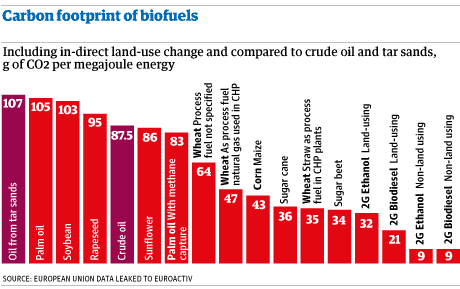
It is obvious that for a biofuel to be useful in cutting the emissions driving global warming it needs to have a smaller carbon footprint than regular fuel from crude oil. So I have added the numbers for crude oil and oil from the highly-polluting tar sands for reference in the table below. The leaked biofuel numbers are, I'm told similar to several recent studies, and therefore credible.

Here's the data (the units are grams of carbon dioxide per megajoule energy of energy).

Biofuels graphic

So palm oil and soy bean biodiesel is just a touch less polluting than fuel from tar sands: that's pretty damning. Maize and sugar do better than crude oil but still cause significant carbon emissions.

The better news comes from the second generation fuels (2G), particularly when the are "non-land using", i.e. when they use only waste such as straw. Factories doing this are setting up now in, for example, Italy. The "land-using" fuels are made from non-food crops, such as jatropha, but that can bring its own problems, as I saw for myself in Tanzania.

The EU's scheme for certifying biofuels as sustainable requires them to emit 35% less CO2 than regular fuel, increasing to 60% by 2018, making palm oil, soy bean, rapeseed and sunflower looking all but dead.

Palm oil biodiesel also received another blow on Friday, with the US Environmental Protection Agency suggesting it fails to meet the US requirement of emitting at least 20% less carbon than diesel from crude oil.

Robbie Blake, biofuels campaigner, at Friends of the Earth Europe, told me: "It's getting quite indisputable that the use of soy or palm oil to fuel our cars is even dirtier than conventional fossil fuels. Forests in Asia and South America are being destroyed by the expansion of plantations to meet the European market. It's a delusion for politicians to think that biodiesel will solve climate change."

The European Union's target for 10% of all transport fuels to be biofuels by 2020 has been described as "unethical" because the production of some types violates human rights and damages the environment. But the same researchers described do nothing to find alternative to the fossil fuels that currently power transport as "immoral".

So the difficult task of distinguishing good and bad biofuels remains essential, as does the research of even more promising technologies, such as algae and seaweed.


http://www.guardian.co.uk/environment/damian-carrington-blog/2012/jan/27/biofuels-biodiesel-ethanol-palm-oil

Thursday, December 15, 2011

EcoBuild 2011 Trade Show Washington,DC

Interesting items at EcoBuild 2011 trade show in Washington, DC, December 8, 2011 -


Tuesday, July 12, 2011

Aiming 4 Zero

Feature: Absolute Zero

Despite the downturn, home builders take lead role in energy and water efficiency.

Source: BIG BUILDER Magazine
Publication date: 2011-07-01

By Steve Doyle and Cary Lowe


Photo: Courtesy Toll Brothers
SOLAR STRATEGY: Toll Brothers is making solar panels available on homes in several of its communities, including Vista del Verde in Yorba Linda, Calif. The solar panels don't add extra dollars to the sales price since they are owned by a third party and leased to the homeowners.


In most endeavors, striving for a score of zero is a fool's errand.

In green home building, however, it is the gold standard. The trick is to keep it from becoming fool's gold.

Despite the housing downturn and its drag on home builders, real progress has been made toward achieving the goal of building homes that consume no net energy. Unquestionably, some of this progress has been forced by the government. Still, the home building industry, battered as it has been, is taking a leading role in the movement toward reducing consumption of energy and water resources. It is realistic to expect that, over the next few years, energy use in new homes will approach zero, and water use will drop to a level one could call insignificant.

Using California as a case study, consider how far the industry has come. Homes built in the last few years use 25 percent less energy, and generate 25 percent less greenhouse gas emissions, than those built just 20 years ago. This results from relatively simple improvements in building materials, construction techniques, insulation, and appliances.

Similarly, recently constructed homes use one-third less water indoors than those built in the mid-1970s, simply due to installation of more efficient fixtures. These are production homes, using standard features. The numbers are even more impressive for homes which incorporate custom, high-efficiency features, and photovoltaic or other onsite power generation facilities.

New homes in California account for a growth of only about 1 percent of the total housing stock in a given year during strong economic times—and only a third of that during the current recession. About 60 percent of homes statewide predate any meaningful energy conservation requirements, and more than 80 percent predate water-conservation standards. Achieving significant improvements in energy and water efficiency in the residential stock would require retrofitting large numbers of those older homes. That will happen over time, driven by the utility cost savings associated with such efficiencies.

Meanwhile, new housing stock begins to demonstrate the efficiencies that can be achieved and, over time, R&D in new-home building will gradually make them more affordable.

Much of this improvement in home efficiency has been driven by changes in the California Building Standards Code, contained in Title 24 of the California Code of Regulations. What began as a set of standards and requirements related to safety and structural integrity has evolved to address environmental issues of concern to the state and its residents. This has focused most heavily on achieving greater energy efficiency.

The need for space heating and cooling has been dramatically reduced by more efficient air-conditioning units, improved wall and attic insulation, heat-resistant windows, better sealing of ductwork, and passive energy design systems. Energy use related to domestic water has been reduced through more efficient water heaters, recirculating hot water systems, and insulated pipes. Electrical demand has been further reduced by installation of more efficient lighting fixtures and domestic appliances. (On the other hand, increasing consumer desire for the newest and best in electronic gadgetry continually adds to the per-person demand for electrical power.)

In recent years, as water supply has become an increasingly critical consideration in connection with new development, Title 24 has focused on water conservation as well, setting standards for more efficient plumbing fixtures and water-using appliances.

Photo: Brookfield Homes
Energy conservation:-Tight ducts (less than 6% leakage) -Radiant barrier roof sheathing-Tankless water heaters-R-30 or 38 ceiling insulation-Low-E windowsRenewable energy: -Photovoltaic solar panels (optional)Water conservation: -WaterSense bath faucets-Low-flow showerheads-Tankless water heaters-Insulated hot water loop lines-Water-sensitive landscaping-Dual-flush toilets (optional)


Photo: Brookfield Homes
How LowCan You Go? Houses in Brookfield Homes' Rockrose community extend 35 percent above California's energy-efficiency standards. The eco-savvy homes focus on energy efficiency, water conservation, indoor air quality, as well as other environmentally friendly features. As part of Brookfield's focus on water conservation and environmentally friendly features, its Rockrose community showcases native and drought-tolerant plants. The builder also engages prospective home buyers with its sales office displays that tell its eco-savvy story.


This trend toward increasing conservation and efficiency requirements was accelerated by enactment of A.B. 32, the California Global Warming Solutions Act, in 2006. With about 22 percent of greenhouse gas emissions in California attributable to residential and commercial buildings, clamping down further on energy consumption is vital to meeting the emissions reduction standards of A.B. 32.

That has been a prime driver behind the California Green Building Standards Code, now incorporated into Title 24. As part of a broad array of environmentally friendly building requirements, the new code includes requirements for accurate sizing of heating and cooling systems, sealing and insulation of ductwork, and sealing of openings between conditioned and unconditioned space. It also includes changes for plumbing fixtures that will result in a 20 percent reduction in potable water use, as well as weather or moisture-based outdoor irrigation controllers.

In addition to satisfying environmental regulatory requirements, these kinds of features will produce substantial cost savings for homeowners. The average California household consumes about 5,900 kilowatt hours per year. Based on typical utility rates, reducing their electrical consumption by one-third would result in an annual savings of about $375. Because electrical rates are tiered, with higher per-unit costs for higher levels of consumption, a household using 10,000 kilowatt hours per year would save nearly $1,000 annually.

Similarly, a typical new single-family home consumes about 59,000 gallons of indoor potable water and about 115,000 gallons for outdoor irrigation annually. Reducing the indoor use by 20 percent pursuant to the new code, combined with an achievable reduction of 40 percent in outdoor irrigation, would save about $300 annually. Again, because of tiered water rates, the savings would be much greater for homes with more fixtures and more landscaping.

Some home builders are taking the quest for efficiency significantly further. Brookfield Homes' Rockrose community in Carlsbad, Calif., is incorporating standard features that reduce energy consumption by 35 percent below Title 24 requirements. These features include radiant barrier roofs, more thermal-resistant windows, quality installation of insulation, insulated and tightly sealed ductwork, tankless water heaters, and highefficiency furnaces. Photovoltaic solar panels are available as an option.

Water consumption is reduced further by the use of dual-flush toilets, looped and insulated hot water lines, high-efficiency irrigation controllers, and drought-resistant landscaping.

Other builders are trying different approaches.

Toll Brothers is introducing a variety of energy-saving options but is focusing particularly on renewable energy generation. The company is making photovoltaic solar panels available on homes in several projects, including in the Vista del Verde community in Yorba Linda, Calif., at no increase in sales price, by having the panels owned by a third party and leased to homeowners, who then receive lower-cost electricity. Toll similarly is making available geothermal heating and cooling systems in projects such as the Hills at Southpoint in Durham, N.C. KB Home is installing solar panels as a standard feature in several new projects. Pacific Housing is taking this a step further in a Sacramento project, installing a battery storage system as a backup to rooftop solar panels.

Surprisingly, these kinds of features are not significantly impacting housing affordability. Taking into consideration all rebates and tax credits available, construction costs in the Brookfield project are only increased by $1.50 per square foot on a net basis, allowing it to remain one of the most affordable new housing developments in San Diego County. This project also benefits from the moderate, coastal Southern California climate; such energy efficiency improvements would cost considerably more in the warmer inland climate zones.

In Phoenix and other markets, Meritage Homes has been able to include an array of energy-saving features, including solar energy, while keeping sales prices under $230,000 for a 3,000-squarefoot home, by incorporating these elements into their standard design rather than adding them as options. Moreover, as an optional upgrade, they are offering sufficient additional solar panels to eliminate electrical service costs.

As these kinds of offerings become more commonplace in the home building industry, the question will be how far such efficiency can be taken, particularly by production builders. The goal of many developers, consumers, and environmentalists is to be able to produce homes that are net zero with regard to resource impacts, i.e., homes with on-site features that reduce consumption to zero, through some combination of efficiency and renewable energy generation.

To achieve such net zero results with regard to energy will require taking significant additional steps in most cases. These might include thicker exterior walls, heat-resistant roof tiles, higherefficiency heating and cooling equipment, conditioned attic space, passive heating and ventilation features, fewer and better insulated windows, strategic orientation of the structure, and planting of deciduous trees. In all likelihood, it also will require installation of on-site energy generation facilities, particularly photovoltaic solar, geothermal, solar water heating, and/or wind turbines. This is all readily doable now, but at a cost of $40,000 to 50,000 for a typical new detached home.

Photo: Courtesy KB Homes
KB Home is another builder installing solar panels as a standard feature in several of its new projects, including Newbury at the Enclave in Eastvale, Calif.

At the same time, an energy savings greater than that available from a full range of green building features can be obtained by simply locating homes in walkable communities or transit-oriented locations, as energy use and greenhouse gas emissions associated with vehicular transportation typically exceed those of the house itself. Such locational considerations will be increasing in significance in California, in particular, as the state implements not only the mandates of A.B. 32 but also other statutory requirements for reduction of vehiclerelated environmental impacts.

Bringing water consumption down to net zero is more challenging. Significant reductions can be achieved by using the lowest-flow fixtures indoors, planting the most drought-resistant landscaping, and using both collected stormwater and domestic gray water for irrigation. However, in the absence of onsite water treatment capability, net zero will not be achievable.

Individual zero-energy custom homes are popping up, especially in areas with temperate climates, and a handful of zero-energy subdivisions are being built. These homes typically also receive LEED certifications and come with a certain cachet of environmental consciousness.

It is reasonable to ask, however, whether achieving zero-energy status and near-zero water status is a particularly worthwhile goal.

Noted new urbanist architect Andres Duany has taken the lead in criticizing LEED and other similar programs for requiring large expenditures to meet extreme standards, when nearly the same level of environmental gain can be achieved at far less cost. Achieving that last increment comes with a highly disproportionate price tag. Just as a given level of energy reduction can be achieved through retrofitting older homes at one-eighth the cost of achieving the same reduction in already more-efficient new homes, the cost of taking a standard new home to a zero net energy level could instead pay for signifi- cant energy reductions in several new homes. Furthermore, new urban, infill, and transitoriented developments already substantially reduce their energy use footprint simply by virtue of their locations, and therefore should be viewed as effectively below net zero compared with new homes in locations that generate high vehicle miles traveled.

Zero net energy is a lofty goal, and its application to even a small percentage of new homes serves as a proving ground for new technologies and new design methods, some of which can be applied to production homes. It is not, however, a feasible or practical approach for all new housing. Nor should it be.

We can accomplish far more in the way of reducing our energy and water use by applying more cost-effective methods on a larger scale, to both new housing and the existing housing stock. This will take political courage, however, because new homes do not have a political constituency, while existing homes certainly do.

Until conservation and efficiency become real goals for the general public throughout the country, new housing alone will bear the financial burden, to the detriment of both housing affordability and environmental goals.

BB Steve Doyle is president of Brookfield Homes, San Diego. Cary Lowe is a San Diego land use lawyer and planning consultant.


http://www.bigbuilderonline.com/Industry-news.asp?articleID=1603853&cid=NWBD110712002

Wednesday, June 15, 2011

Victory gardens: a model for a more sustainable food future

By , Published: May 25

Since Britain’s Prince Charles came to town this month to talk up the vital need for more sustainable food systems, another event pressed the message home for me: exploding watermelons.

In China, the land of lethal milk, toxic pet food and tainted honey, we now have cucurbits that have spontaneously detonated after farmers sprayed them with a growth hormone. Read the label, guys!

The industrialization of agriculture is one thing; the globalization of it is something else. The closer I am to the source of the veggies I eat, the better I feel about myself and the planet. The most satisfying food on my plate is the carrot or pea that I knew as a seed. In my garden, I’ve been harvesting fattening heads of lettuce this month along with great quantities of kale, all grown with a small investment of money — a few dollars for seed — and the delightful duty of raising these plants. I’ve just put in some tomatoes I started in March and sowed some parsnip seed for a fall harvest. The beans and cucumbers will be close behind. The cycle spins merrily.

I don’t mention this to be smug (well, perhaps a little) but to reinforce what Prince Charles was exhorting at Georgetown University at the Future of Food conference, organized by Washington Post Live. His message, shared by a whole modern movement, is that our system of industrial agriculture is ultimately bad for our planet, if not our bodies. The conference speakers and panelists want to see a shift to organically grown food that is raised far closer to market. For them, this invariably comes down to a much larger network of small, local and regional farms and cooperatives supplying supermarkets and consumers directly through farm stands, farmers markets and community-supported agriculture cooperatives.

What seems to be flying under almost everyone’s radar is the difference millions of home vegetable gardens could make. This is a missed opportunity. If there were some almighty crisis that imperiled our food supply — exploding watermelons? — many of us have the potential, at least, to sustain much of our needs. The model exists in the victory garden that emerged in World War I and reached its zenith in World War II, when vegetables grown by homeowners and other amateurs supplied 40 percent of the nation’s needs.

Many of these 20 million gardens took the form of community gardens on vacant city land or at highly visible sites such as the White House or New York City mansions. Apart from the two-year-old vegetable garden at the White House, many of these urban farms and community gardens have either survived or are being reinvented in our time in cities such as New York, Philadelphia and Baltimore. One of the conference speakers, Will Allen, has established successful inner-city farms in Milwaukee as a national model.

As laudable as these programs are, the movement needs to tap into every cross section of society, not least the suburban gardener. “It doesn’t seem like the suburban homeowner is being included in this,” said Laura Lawson, author of “City Bountiful: A Century of Community Gardening in America.” Victory gardens were successful because everyone was in it together, and the movement was something positive in the face of a crisis. The current debate, she says, “is not joyous, it’s reactionary.” Lawson chairs the landscape architecture department at Rutgers University.

In terms of the home victory garden, an exemplar persists in a fascinating wartime instructional film by Uncle Sam, which can be seen at www.archive.org/details/
victory_garden
. Here the Holder family somewhere in northern Maryland (real or fictional, we wonder?) is shown creating a quarter-acre victory garden.

On several levels the film is sorely dated; on others it is not, offering valid and honest practical advice. If such a victory garden were planted today, it would be smaller, the soil would be mulched, with more compost and fewer and safer pesticides. We’d have more productive varieties, perhaps more trellising and a greater emphasis on fresh multi-seasonal veggies and less on canning.

I’d like to think we would still have as much teenage gusto to keep it humming along, though obviously there were aspects of gardening then, as now, that were burdensome. Indeed, soon after the war ended, most victory gardens quickly vanished.

This may not have been due to sloth as much as a new patriotic imperative. “The whole focus of the country turns to consumption,” said Amy Bentley, author of “Eating for Victory.” “Automobiles, houses, appliances. That whole ethos is directly contradictory to the previous ethos of saving and doing it yourself.”

And the gardening, when it occurred, wasn’t always the Catoctin cornucopia captured in the propaganda film. A lot of folks tried it but failed, especially in urban areas where the farming touch was already lost. But generally it worked, in part because there was food rationing and because people realized they could make a difference. “It was successful because it was needed, but it was also a concrete, visceral way to contribute to the war effort that wasn’t just sacrificing,” said Bentley, who is also an associate professor of food studies at New York University.

I think there will come a time when we will need victory gardens on every block, in a post-industrial, post-global planet, when advancement is measured in localizing our world, not expanding it. It will be medieval, in the best sense, but with law and order and antibiotics.

I think we are already moving toward that place. People such as Rosalind Creasy are showing us that fruit and vegetable gardens can be beautiful while making a statement. The lawn as landscape icon was a declaration that you didn’t have to farm anymore. Perhaps we can replace it with a front-yard veggie garden that declares the age of the lawn over. What a proclamation that would be for thrift, self-sufficiency, horticultural skill, concern for the environment and the world we pass on.

Prince Charles said the other day that “we have to put nature back at the heart of the equation.” I think we should put every gardener at the center of it, too.

Follow @adrian_higgins on Twitter for updates on gardening and other cosmic events.


http://www.washingtonpost.com/lifestyle/home_garden/victory-gardens-a-model-for-a-more-sustainable-food-future/2011/05/18/AGsc2MBH_story.html

Tuesday, June 14, 2011

Paying For Trouble - When You Think What You Buy Is Safe

She had her house sprayed for fleas, and then the trouble began

By Sue Eisenfeld, Published: May 23

Last winter, despite a low-level warning beacon in my gut, I hired a company to apply a chemical flea treatment in our house. Not wanting to waste time on home remedies that might not work, I thought, “Let’s just get it over with.”

I made this decision even though I’d been a “ban lawn-care pesticides from our campus” activist in college and had spent nearly my entire professional life as a communications consultant to the Environmental Protection Agency, writing materials for the public about environmentally sound behavior.

As an environmentalist, I am an organic vegetarian. I avoid processed foods with ingredient names I can’t pronounce, use reusable tote bags, avidly recycle and drive a low-emissions car.

Yet, on the eve of my decision, I looked at my poor kitty. Despite applications of topical anti-flea drops, he’d been licking himself raw during the past four months. I had to take some kind of action, and fast.

The treatment seemed reasonable: An aerosol flea spray would be applied directly to the floor; it wasn’t some kind of flea bomb or fogger. I assumed that if there were risks or warnings or precautions I should know about, the pest control company, which we’d used to treat the exterior of our house against ants, would tell me. I decided to trust “the system” — which, I reasoned, was created to protect consumers, after all.

The next morning a man came to our house with two aerosol cans of a pesticide and targeted our hardwood floors and rugs, as well as the concrete floor in the basement. The pesticide — in the form of a mist designed to fall quickly to the floor — contained chemicals to kill insects and interrupt the life cycle of fleas.

The technician didn’t provide any instructions other than to take the cat and stay out of the house for three to four hours until the product had dried.

Six hours later, my husband and I returned home and found big wet drops all over the floors. When we called the pest control company, the manager was perplexed. He recommended that we mop up the residue, then throw away the sponge.

While my husband did the mopping, I wrote an instant message to a friend: “This is a disaster,” I typed. “Don’t worry about it,” he wrote back. “It’s no big deal.”

Strange symptoms

The next morning, I awoke to a headache in the back right quadrant of my skull. I felt a bit woozy and off balance and figured I was coming down with a cold. By evening, my arms were buzzing with an odd, electric energy. My husband and my cat were fine.

The next day, my left arm and leg felt icy hot. And my torso reacted to cold as if it were being stung by yellow jackets.

In another 24 hours, my fatigue was so intense that even if the house had been on fire, I couldn’t have peeled myself out of bed. A day later, my right side lost much of its strength. I struggled to brush my teeth, write, type and lift a fork. Standing up in the shower and lathering my hair became things I could no longer do at once.

Two trips to the emergency room ruled out a stroke and a brain tumor. But an MRI scan showed a lesion on the spinal cord in my neck. This scar or defect, I was told, had chewed away some of the protective myelin that coats nerves and transmits messages in the nervous system. This damage was scrambling messages being sent throughout my body about temperature and pain and strength and balance.

Process of elimination

A week after my symptoms began, a neurologist diagnosed the problem as transverse myelitis, an inflammation of the spinal cord. Until my spinal tap and blood test results came back, he couldn’t tell me the cause.

Transverse myelitis can be the result of a viral infection such as chickenpox, shingles, herpes, flu, HIV, hepatitis A or rubella. It can also be caused by abnormal immune system reactions, and it’s sometimes a complication of syphilis, measles or Lyme disease.

The neurologist said my symptoms could also be caused by multiple sclerosis, lupus, thyroid disorder, tuberculosis or other diseases.

“What about pesticide exposure?” I asked.

My doctor listened to the story of the chemical flea treatment and the coincidental timing of the onset of symptoms, and then rushed out of the room to call the manufacturer of the chemical spray. When he came back, he reported that the company’s medical staff said no one there had heard that their product had caused such symptoms.

“It’s concerning, however,” my doctor said. “And I sure wouldn’t use that stuff myself.”

He put me on a megadose of intravenous steroids for five days, then steroid pills for a week. My icy-hot sensation began to fade, and my strength began to return, although a full recovery took several months.

Soon my test results started streaming in. Lyme disease: negative. Lupus: negative. Meningitis: negative. Tuberculosis: negative. Cancer cells: negative. But four tests involving the cerebrospinal fluid that are often used as indicators of multiple sclerosis came up positive — stunningly unpleasant news that made my mind swirl.

“We can’t know for sure about multiple sclerosis,” my neurologist explained, “until you get a follow-up MRI in four to five months, to see whether the lesion is still there or if there are any new ones.” A definitive diagnosis, he explained, requires either two “episodes” like the one I had experienced, or two or more lesions on the spinal cord. I would now just have to wait.

Seeking information

My recovery involved physical therapy, occupational therapy, exercise and rest. My mental recuperation required research. I wanted to know more about this pesticide.

First I found the pesticide label online, with its information about using the product properly. What this told me was that the technician had not given me enough information. The label instructs users to cover all food-processing surfaces, utensils and exposed food prior to spraying. We hadn’t been told to do anything like that — to remove the dishes sitting out on our drying rack, to cover our cutting board or the fruit and vegetables on our counter.

The label directs pesticide applicators to avoid thoroughly wetting the surfaces being sprayed. Yet there had been those drops on the floor six hours later. It also says that the sprayed area should be ventilated after treatment. News to us.

I then contacted the pest control company and the manufacturer to report the incident. The pest control company said that an experienced technician had done the work. The manufacturer declared that information about any reports of health effects was proprietary.

So I filed a Freedom of Information Act request with the EPA, the federal agency responsible for regulating pesticides. Although incident reports made to the manufacturer may be considered proprietary, the manufacturer must give them to the EPA, which also collects incident reports from the public and from other government agencies and nongovernmental organizations.

A few weeks later, I got my response: an 82-page report from the EPA that made it clear to me that MS wasn’t the cause of my symptoms. The report showed that from 1992 until early 2010, 156 “minor” human incidents had been reported to the agency concerning the product used in our house, as well as 24 “moderate” and 515 “major” human incidents.

Among the complaints in the moderate and major medical incidents were dizziness, difficulty breathing, difficulty swallowing, muscle weakness, tremors, abdominal pain, disorientation, stumbling, coma, seizure, liver failure, lethargy, numbness, blurred vision, chills, blood in the urine, memory loss, migraines, inability to walk and heart attack.

A second FOIA request about three of the active ingredients in “my” pesticide revealed that thousands of medical complaints had been filed about these chemicals when they were used in other pesticide products.

Four months after my neurological episode, when I was finally able to walk in a straight line and not have my right hand buzz every time I bent my head toward my chest, I had another MRI. As I had expected — after weeks of follow-up neurological studies, blood tests and second opinions — the possible MS diagnosis was thrown out. My spinal cord lesion — attributed to, as my neurologist put it, “an autoimmune response to pesticide exposure” — had vanished.

At home, I threw away our conventional cleaning products and purchased all-natural cleaners. I canceled our quarterly outdoor pesticide treatment against ants. I bought essential-oil bug spray for summertime mosquitoes. I returned to working on the book I had just started to write and the new career I had launched.

I could have left it at that: gratitude, a new beginning, a renewed commitment to health. But I knew something more needed to be done to prevent incidents like mine — or worse — from happening to others. So here’s what I learned:

Consumers must receive more information about the pesticides being used in their homes. And they need regulatory backup protection.

If the company I dealt with had been required by law to show me the label information or read it to me aloud like a Miranda warning, I would have put away the apples and tomatoes, covered the cutting board and dishes, and, later, opened the windows and set up fans.

Similarly, if, before treating my house, the pest company had been required to provide me with the EPA’s Citizen’s Guide to Pest Control and Pesticide Safety — much as contractors, home sellers and landlords are required to give occupants certain brochures about the hazards of lead-based paint — I might have been encouraged to evaluate less-toxic alternatives or ask more questions.

If the label information had provided directions for contacting my state pesticide regulatory agency to report misuse or problems, I might have called soon after my problems surfaced. The agency could have sent an investigator to my house in Virginia to collect evidence to determine if the pest control company had broken any laws.

Finding pesticide residues on a food preparation surface or on a cat’s water bowl “would hang an applicator,” one state investigator told me. Not obeying the label instructions is a violation of federal and state law, and in Virginia, the company could be fined up to $5,000 for this violation, a penalty that could motivate it to train its technicians better and provide homeowners with more information.

Beyond that, it’s time to improve the system for regulating pesticides. Congress and other policymakers should reform the Federal Insecticide, Fungicide, and Rodenticide Act of 1947 and the EPA regulations that implement it. Pesticide manufacturers, in performing mandatory safety studies before their products are allowed on the market, should be required to test the combined effects of multiple pesticides and the effects of their pesticides combined with chemicals that people are exposed to each day, such as plastics and drugs.

Manufacturers should also be required to tell the EPA and consumers what the “inert” or “other” ingredients are that can make up 95 percent of a pesticide product: Some of these substan-ces can be even more toxic than the active ingredients.

The federal pesticide law or EPA needs to better define what kinds of detrimental effects are unreasonable for people to suffer. Currently, if a pesticide performs its intended function without “unreasonable adverse effects” to human health or the environment when used according to label instructions, it is allowed on the market. But the law never defines “unreasonable.” It says only that to determine “unreason­able risk,” EPA must take into ac­count “the economic, social, and envi­ronmental costs and benefits.”

Finally, EPA should be required to assess whether any “green” products can achieve the same results as pesticides, with less risk. The federal law should require an assessment of such alternatives as part of the pesticide approval process, eventually restricting the use of certain chemicals as safer approaches and technologies become available. This idea would be a new way of thinking, but it is time for the outdated regulatory approach to pesticides to move into the future.

My decision to use a chemical pesticide in my home was a moment of weakness, a test of blind faith in a system that was supposed to protect me from harm. No one knows why I was affected and others in my household weren’t. Thankfully, I am completely recovered.

Yet, the desire for quick, no-fuss ways to get rid of bugs will never fade. Without additional protections, unwary consumers will continue to turn to chemical products they assume are safe. They will find that they may be protected from bugs — but not from harm.

Eisenfeld is a writer and editor in the Washington area. This article was excerpted from the May issue of Health Affairs and can be read in full online at www.healthaffairs.org.


http://www.washingtonpost.com/national/health/she-had-her-house-sprayed-for-fleas-and-then-the-trouble-began/2011/04/21/AFmjC49G_story.html